Komatsu extends 3D Machine Guidance Flex to non-excavators
The retrofit system brings in-cab 3D guidance and automated as-built data collection to mixed equipment fleets. www.komatsu.com Komatsu Europe has expanded its Smart Construction portfolio with the introduction of 3D Machine Guidance Flex, a solution tailored for bulldozers, wheel loaders, dump trucks, and other non-excavator equipment. Building on a hardware platform that has already seen over 9,000 installations on tracked and wheeled excavators, this cost-effective retrofit system brings real-time 3D guidance and automated data collection to a much broader range of machinery, giving contractors a digitized, comprehensive view of mixed-fleet operations. Real-time guidance and seamless data capture Rather than integrating deeply with a machine’s complex hydraulic work equipment, the Flex system measures movement directly from the tracks or wheels. This allows operators to view their exact distance from target design surfaces and monitor real-time heat maps of completed work via an in-cab display, from which they can also generate simple flat surfaces and slopes. As the machine moves, it continuously logs high-density, georeferenced as-built data. According to Ian De Dobbelaere, Commercial Project Manager at Komatsu, this turns everyday machinery into active data collectors, ensuring that every pass altering the jobsite is captured and fed into digital-twin platforms. Smart Construction integration and remote support The collected as-built data seamlessly synchronizes with the Smart Construction Dashboard, combining connected machine inputs with project designs to provide project management teams with a continuously updated 3D view of the site. This reduces the reliance on manual on-site progress surveys and improves the accuracy of volume calculations. To further streamline operations, the 3D Machine Guidance Flex system includes eight years of access to Smart Construction Remote. This connectivity allows authorized personnel to transfer design files directly to machines in the field and provide remote operator support by viewing and controlling the in-cab display, drastically reducing the need for physical site visits. Additional Context: Kinematic tracking and GNSS RTK in earthmoving This section details georeferencing technologies and sensor architectures not included in the original press release. In heavy civil construction, capturing actionable "as-built" data requires centimeter-level localization, typically achieved via Real-Time Kinematic (RTK) GNSS. While standard GPS is only accurate to within a few meters, RTK utilizes a stationary local base station or a cellular Virtual Reference Station (VRS) network to broadcast phase-correction signals to the machine's receiver. Traditional 3D machine control for excavators requires expensive Inertial Measurement Units (IMUs) mounted on the boom, stick, and bucket to calculate the exact position of the cutting edge in 3D space. By shifting the measurement reference point to the tracks or wheels (the machine's physical footprint) rather than the digging implement, the "Flex" system bypasses the need for complex, multi-sensor kinematic arrays. While this approach does not provide the millimeter-level automated blade grading precision of Komatsu's fully integrated Intelligent Machine Control (iMC), it perfectly captures bulk material movement, haul routes, and compaction passes. This generates highly accurate volumetric heat maps across an entire mixed fleet without the steep hardware integration costs of implement-level tracking. Edited by an industrial journalist, Lekshman Ramdas, with AI assistance. www.komatsu.com Powered by Induportals Media Publishing
 machineryasia

The retrofit system brings in-cab 3D guidance and automated as-built data collection to mixed equipment fleets.
www.komatsu.com
Komatsu Europe has expanded its Smart Construction portfolio with the introduction of 3D Machine Guidance Flex, a solution tailored for bulldozers, wheel loaders, dump trucks, and other non-excavator equipment. Building on a hardware platform that has already seen over 9,000 installations on tracked and wheeled excavators, this cost-effective retrofit system brings real-time 3D guidance and automated data collection to a much broader range of machinery, giving contractors a digitized, comprehensive view of mixed-fleet operations.
Real-time guidance and seamless data capture
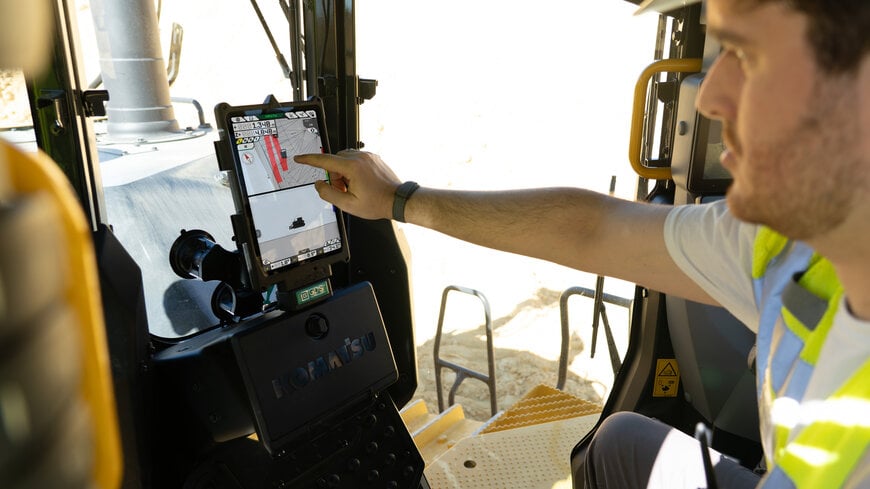
Rather than integrating deeply with a machine’s complex hydraulic work equipment, the Flex system measures movement directly from the tracks or wheels. This allows operators to view their exact distance from target design surfaces and monitor real-time heat maps of completed work via an in-cab display, from which they can also generate simple flat surfaces and slopes. As the machine moves, it continuously logs high-density, georeferenced as-built data. According to Ian De Dobbelaere, Commercial Project Manager at Komatsu, this turns everyday machinery into active data collectors, ensuring that every pass altering the jobsite is captured and fed into digital-twin platforms.
Smart Construction integration and remote support
The collected as-built data seamlessly synchronizes with the Smart Construction Dashboard, combining connected machine inputs with project designs to provide project management teams with a continuously updated 3D view of the site. This reduces the reliance on manual on-site progress surveys and improves the accuracy of volume calculations. To further streamline operations, the 3D Machine Guidance Flex system includes eight years of access to Smart Construction Remote. This connectivity allows authorized personnel to transfer design files directly to machines in the field and provide remote operator support by viewing and controlling the in-cab display, drastically reducing the need for physical site visits.
Additional Context: Kinematic tracking and GNSS RTK in earthmoving
This section details georeferencing technologies and sensor architectures not included in the original press release.
In heavy civil construction, capturing actionable "as-built" data requires centimeter-level localization, typically achieved via Real-Time Kinematic (RTK) GNSS. While standard GPS is only accurate to within a few meters, RTK utilizes a stationary local base station or a cellular Virtual Reference Station (VRS) network to broadcast phase-correction signals to the machine's receiver. Traditional 3D machine control for excavators requires expensive Inertial Measurement Units (IMUs) mounted on the boom, stick, and bucket to calculate the exact position of the cutting edge in 3D space. By shifting the measurement reference point to the tracks or wheels (the machine's physical footprint) rather than the digging implement, the "Flex" system bypasses the need for complex, multi-sensor kinematic arrays. While this approach does not provide the millimeter-level automated blade grading precision of Komatsu's fully integrated Intelligent Machine Control (iMC), it perfectly captures bulk material movement, haul routes, and compaction passes. This generates highly accurate volumetric heat maps across an entire mixed fleet without the steep hardware integration costs of implement-level tracking.
Edited by an industrial journalist, Lekshman Ramdas, with AI assistance.
www.komatsu.com
Powered by
Induportals Media Publishing