Hybrid Transmission for Mobile Cranes and Special Vehicles
ZF's TraXon Hybrid 2 combines a 12-speed automated manual transmission with a high-voltage electric drive for electric maneuvering and working on construction sites. www.zf.com Mobile cranes combine long road journeys, precise maneuvering on construction sites and intensive working cycles in one vehicle, which makes electrifying their driveline technically demanding. ZF presented TraXon Hybrid 2, a hybrid transmission solution in development for mobile cranes and other special-purpose vehicles, at bauma China, held in Shanghai from November 23 to 27, 2026. Driveline Requirements of Mobile Cranes Mobile cranes travel significant distances on public roads, maneuver in confined spaces and carry out heavy working operations. A single driveline therefore has to cover several operating modes. Electric operation adds an option for maneuvering and working in urban or emissions-sensitive environments, while the combustion engine maintains the range needed for longer journeys and heavy-duty cycles. TraXon Hybrid 2 is designed to cover these modes within one driveline concept. Hybrid Module and System Architecture TraXon Hybrid 2 builds on ZF's established 12-speed TraXon 2 automated manual transmission and adds a high-voltage hybrid module. The permanent-magnet synchronous motor currently delivers up to 225 kW peak output and 190 kW over 30 minutes. The module combines the electric motor, a single-stage planetary gearset and a separate silicon-carbide inverter, with hybrid functionality integrated into the transmission control software. An Intarder and a power take-off can also be incorporated. Integration into Existing Vehicle Platforms Because the solution is based on TraXon 2, it can be fitted into existing vehicle platforms. Manufacturers can therefore introduce electrified driving and working functions without developing an entirely new driveline architecture. ZF also provides system integration and application support. Operating Modes from Road to Work Site Hybrid and plug-in hybrid configurations allow locally emission-free driving and working in electric mode, for example for the last mile, for maneuvering and for onsite work. The conventional driveline remains available for longer road journeys, and the batteries can be charged during transit so the vehicle is ready for operation at the jobsite. Because electric mode relieves the diesel engine, it can result in less wear and lower maintenance costs. With a suitable vehicle architecture, the system can also support electrically powered crane operation. Recuperation recovers braking energy, and plug-in capability provides the option of supplying electrical energy externally. In certain markets, ZF is also exploring a generator mode that would allow the transmission system to supply energy for external devices. Additional Context: This section details technical specifications and competitive benchmarking not included in the original product announcement. ZF's on-highway TraXon 2 Hybrid shares the same 12-speed platform. According to ZF product data, it uses an oil-cooled permanent-magnet synchronous hairpin motor rated at 190 kW continuous (UN ECE R85) and 225 kW peak, an independent 520–820 V silicon-carbide inverter and electric actuation of all 12 gears. In ZF simulations, the truck version drives electrically up to 80 km/h with a range of approximately 80 km on a 100 kWh battery. These figures describe the truck variant, and ZF has not published equivalent range data for the crane application, whose duty cycle differs from long-haul operation. Edited by Sucithra Mani, Induportals editor – adapted by AI. www.zf.com Powered by Induportals Media Publishing
 machineryasia
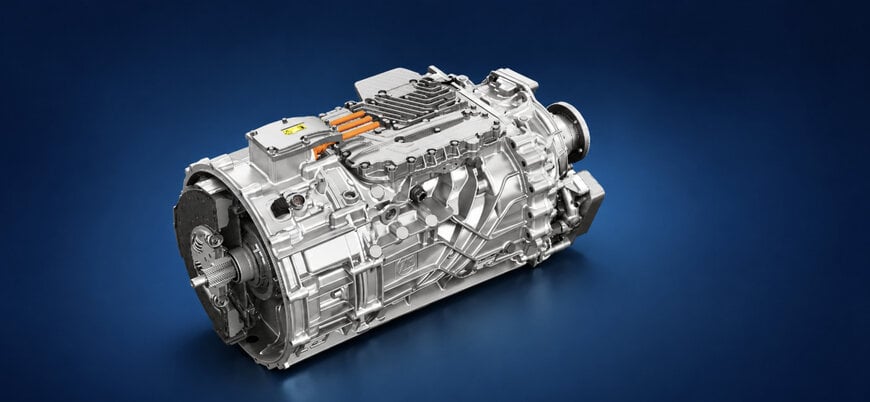
ZF's TraXon Hybrid 2 combines a 12-speed automated manual transmission with a high-voltage electric drive for electric maneuvering and working on construction sites.
www.zf.com
Mobile cranes combine long road journeys, precise maneuvering on construction sites and intensive working cycles in one vehicle, which makes electrifying their driveline technically demanding. ZF presented TraXon Hybrid 2, a hybrid transmission solution in development for mobile cranes and other special-purpose vehicles, at bauma China, held in Shanghai from November 23 to 27, 2026.
Driveline Requirements of Mobile Cranes
Mobile cranes travel significant distances on public roads, maneuver in confined spaces and carry out heavy working operations. A single driveline therefore has to cover several operating modes. Electric operation adds an option for maneuvering and working in urban or emissions-sensitive environments, while the combustion engine maintains the range needed for longer journeys and heavy-duty cycles. TraXon Hybrid 2 is designed to cover these modes within one driveline concept.
Hybrid Module and System Architecture
TraXon Hybrid 2 builds on ZF's established 12-speed TraXon 2 automated manual transmission and adds a high-voltage hybrid module. The permanent-magnet synchronous motor currently delivers up to 225 kW peak output and 190 kW over 30 minutes. The module combines the electric motor, a single-stage planetary gearset and a separate silicon-carbide inverter, with hybrid functionality integrated into the transmission control software. An Intarder and a power take-off can also be incorporated.
Integration into Existing Vehicle Platforms
Because the solution is based on TraXon 2, it can be fitted into existing vehicle platforms. Manufacturers can therefore introduce electrified driving and working functions without developing an entirely new driveline architecture. ZF also provides system integration and application support.
Operating Modes from Road to Work Site
Hybrid and plug-in hybrid configurations allow locally emission-free driving and working in electric mode, for example for the last mile, for maneuvering and for onsite work. The conventional driveline remains available for longer road journeys, and the batteries can be charged during transit so the vehicle is ready for operation at the jobsite. Because electric mode relieves the diesel engine, it can result in less wear and lower maintenance costs. With a suitable vehicle architecture, the system can also support electrically powered crane operation. Recuperation recovers braking energy, and plug-in capability provides the option of supplying electrical energy externally. In certain markets, ZF is also exploring a generator mode that would allow the transmission system to supply energy for external devices.
Additional Context:
This section details technical specifications and competitive benchmarking not included in the original product announcement.
ZF's on-highway TraXon 2 Hybrid shares the same 12-speed platform. According to ZF product data, it uses an oil-cooled permanent-magnet synchronous hairpin motor rated at 190 kW continuous (UN ECE R85) and 225 kW peak, an independent 520–820 V silicon-carbide inverter and electric actuation of all 12 gears. In ZF simulations, the truck version drives electrically up to 80 km/h with a range of approximately 80 km on a 100 kWh battery. These figures describe the truck variant, and ZF has not published equivalent range data for the crane application, whose duty cycle differs from long-haul operation.
Edited by Sucithra Mani, Induportals editor – adapted by AI.
www.zf.com
Powered by
Induportals Media Publishing