Heavy-Duty Mobile Cranes Deploy for Complex Infrastructure Reconstruction
Dietmar Floßdorf GmbH & Co. KG and Leonhard Weiss GmbH & Co. KG deployed two specialized mobile cranes to execute a precise heavy-lift bridge installation within a highly restricted operational footprint. www.liebherr.com Application area: Infrastructure Reconstruction Industry sector: Heavy Lifting and Civil Engineering The project required erecting the new Landgrafen Bridge in Bad Neuenahr-Ahrweiler, a key piece of infrastructure to replace the previous bridge that was completely destroyed during a major flood disaster. The client companies, specialized in heavy haulage, crane operations, and civil construction, faced severe physical limitations on-site. The assembly area directly on the banks of the River Ahr presented extremely confined space conditions that restricted equipment positioning and maneuvers. Overcoming Thermal Expansion and Structural Weight Challenges The main engineering objective was to lift and precisely position a bridge segment weighing a total of 105 tonnes into its designated abutments. To complete this safely, the technical solution needed to satisfy two critical parameters: Accommodating a long maximum reach of 38 metres due to the bank-to-bank span. Mitigating the risk of structural thermal expansion. If the lift occurred during higher daytime temperatures, the steel girder would expand and fail to fit precisely into the fixed abutments. Synchronized Lifting Solution for Restricted Operational Footprints To solve the spatial and load-bearing constraints, two heavy-duty Liebherr LTM 1750-9.1 mobile cranes were selected. Each 9-axle mobile crane was configured with a 28-metre luffing jib and 204 tonnes of counterweight to ensure sufficient safety reserves at the required 38-metre outreach. The machinery was chosen due to its high load capacity and flexible configuration, allowing the units to be erected close together within the narrow riverside footprint. The logistical sequence required the first crane to be positioned and fully assembled first, which then directly assisted in setting up the second crane unit. To manage the 105-tonne load safely between both lifting units, engineers utilized a triangular spreader. This technical feature functioned as a crossbeam to ensure that the massive load remained precisely and evenly distributed between both cranes throughout the entire hoisting sequence. Exacting Execution in Low-Temperature Windows The critical main lift was intentionally scheduled and executed at 4 am. Operating in the early hours of the morning guaranteed the lowest possible ambient temperatures, successfully minimizing the thermal expansion of the steel bridge component to achieve pinpoint placement into the abutments. During the synchronized tandem lift, the crane operators maintained a constant load balance across the triangular spreader. Following the successful positioning of the main structure, one LTM 1750-9.1 crane was dismantled, while the second unit was relocated to the opposite bank of the River Ahr to complete the remaining auxiliary infrastructure installation. Edited by Sucithra Mani, Induportals editor – adapted by AI. www.liebherr.com Powered by Induportals Media Publishing
 machineryasia
Dietmar Floßdorf GmbH & Co. KG and Leonhard Weiss GmbH & Co. KG deployed two specialized mobile cranes to execute a precise heavy-lift bridge installation within a highly restricted operational footprint.
www.liebherr.com
Application area: Infrastructure Reconstruction
Industry sector: Heavy Lifting and Civil Engineering
The project required erecting the new Landgrafen Bridge in Bad Neuenahr-Ahrweiler, a key piece of infrastructure to replace the previous bridge that was completely destroyed during a major flood disaster. The client companies, specialized in heavy haulage, crane operations, and civil construction, faced severe physical limitations on-site. The assembly area directly on the banks of the River Ahr presented extremely confined space conditions that restricted equipment positioning and maneuvers.
Overcoming Thermal Expansion and Structural Weight Challenges
The main engineering objective was to lift and precisely position a bridge segment weighing a total of 105 tonnes into its designated abutments. To complete this safely, the technical solution needed to satisfy two critical parameters:
- Accommodating a long maximum reach of 38 metres due to the bank-to-bank span.
- Mitigating the risk of structural thermal expansion. If the lift occurred during higher daytime temperatures, the steel girder would expand and fail to fit precisely into the fixed abutments.
Synchronized Lifting Solution for Restricted Operational Footprints
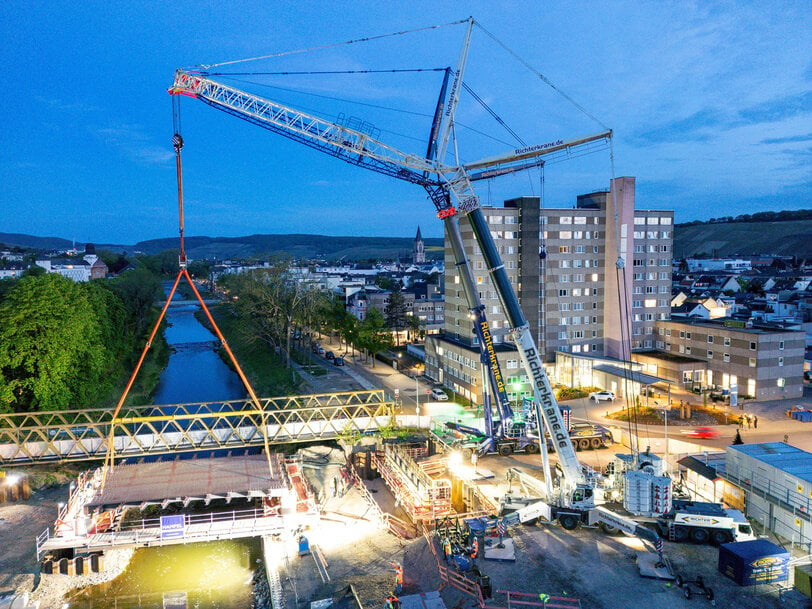
To solve the spatial and load-bearing constraints, two heavy-duty Liebherr LTM 1750-9.1 mobile cranes were selected. Each 9-axle mobile crane was configured with a 28-metre luffing jib and 204 tonnes of counterweight to ensure sufficient safety reserves at the required 38-metre outreach.
The machinery was chosen due to its high load capacity and flexible configuration, allowing the units to be erected close together within the narrow riverside footprint. The logistical sequence required the first crane to be positioned and fully assembled first, which then directly assisted in setting up the second crane unit.
To manage the 105-tonne load safely between both lifting units, engineers utilized a triangular spreader. This technical feature functioned as a crossbeam to ensure that the massive load remained precisely and evenly distributed between both cranes throughout the entire hoisting sequence.
Exacting Execution in Low-Temperature Windows
The critical main lift was intentionally scheduled and executed at 4 am. Operating in the early hours of the morning guaranteed the lowest possible ambient temperatures, successfully minimizing the thermal expansion of the steel bridge component to achieve pinpoint placement into the abutments.
During the synchronized tandem lift, the crane operators maintained a constant load balance across the triangular spreader. Following the successful positioning of the main structure, one LTM 1750-9.1 crane was dismantled, while the second unit was relocated to the opposite bank of the River Ahr to complete the remaining auxiliary infrastructure installation.
Edited by Sucithra Mani, Induportals editor – adapted by AI.
www.liebherr.com
To solve the spatial and load-bearing constraints, two heavy-duty Liebherr LTM 1750-9.1 mobile cranes were selected. Each 9-axle mobile crane was configured with a 28-metre luffing jib and 204 tonnes of counterweight to ensure sufficient safety reserves at the required 38-metre outreach.
The machinery was chosen due to its high load capacity and flexible configuration, allowing the units to be erected close together within the narrow riverside footprint. The logistical sequence required the first crane to be positioned and fully assembled first, which then directly assisted in setting up the second crane unit.
To manage the 105-tonne load safely between both lifting units, engineers utilized a triangular spreader. This technical feature functioned as a crossbeam to ensure that the massive load remained precisely and evenly distributed between both cranes throughout the entire hoisting sequence.
Exacting Execution in Low-Temperature Windows
The critical main lift was intentionally scheduled and executed at 4 am. Operating in the early hours of the morning guaranteed the lowest possible ambient temperatures, successfully minimizing the thermal expansion of the steel bridge component to achieve pinpoint placement into the abutments.
During the synchronized tandem lift, the crane operators maintained a constant load balance across the triangular spreader. Following the successful positioning of the main structure, one LTM 1750-9.1 crane was dismantled, while the second unit was relocated to the opposite bank of the River Ahr to complete the remaining auxiliary infrastructure installation.
Edited by Sucithra Mani, Induportals editor – adapted by AI.
www.liebherr.com
Powered by
Induportals Media Publishing