Fleet Expansion with 3-Axle Mobile Taxi Cranes
Transports Toussaint expands its logistics fleet with the new Liebherr LTM 1055-3.3 mobile crane. www.liebherr.com Industry Sector: Heavy machinery and construction logistics. Application Area: Mobile cranes and regional lifting operations. Transports Toussaint has taken delivery of a Liebherr LTM 1055-3.3, becoming one of the first companies in France to operate this specific 3-axle mobile crane model. The acquisition expands the company's regional lifting capacity, complementing a previously commissioned Liebherr LTM 1090-4.2 unit. Axle Load and Roadworthiness The LTM 1055-3.3 is configured to function as a "taxi crane," meaning it can carry 9 tonnes of counterweight (ballast) while maintaining an axle load of exactly 12 tonnes. This configuration allows the vehicle to travel on public road networks without requiring secondary transport trucks to haul the counterweights separately, thereby reducing setup times and logistical overhead for rapid deployments. Lifting Capacity and Boom Specifications Engineered for operations in the 3-axle class, the crane features a maximum lifting capacity of 55 tonnes. The primary structural component is a 40-metre-long telescopic boom. When fully extended, the mechanical system can achieve lifting heights of up to 54 metres and a maximum horizontal outreach of 46 metres. Additional Context: This section details technical specifications and regulatory benchmarking not included in the original announcement In the European heavy transport sector, the 12-tonne per axle load limit is a critical regulatory threshold. Vehicles operating within this parameter can travel on public roads under standard traffic regulations. If a crane exceeds this axle load due to heavy internal counterweights, it requires special heavy-haul permits, predetermined routing, and often pilot escort vehicles, which drastically increases operational costs and delays deployment. A "taxi crane" optimizes its chassis weight distribution to carry a substantial portion of its required counterweight while remaining legally roadworthy. To achieve this, manufacturers utilize high-tensile fine-grained structural steel for the telescopic boom and chassis, reducing the deadweight of the crane itself to maximize the allowable ballast payload. Edited by Lekshman Ramdas, Induportals editor – adapted by AI. www.liebherr.com Powered by Induportals Media Publishing
 machineryasia
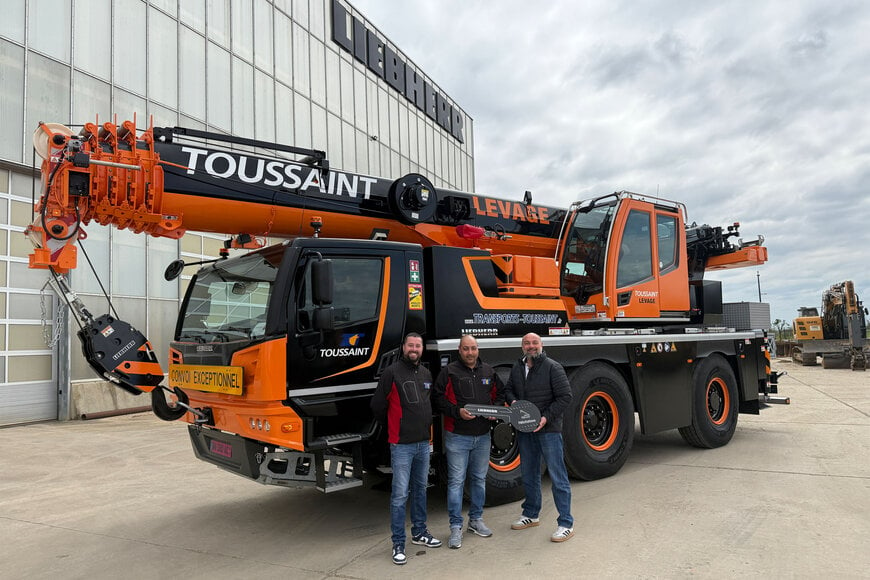
Transports Toussaint expands its logistics fleet with the new Liebherr LTM 1055-3.3 mobile crane.
www.liebherr.com
Industry Sector: Heavy machinery and construction logistics.
Application Area: Mobile cranes and regional lifting operations.
Transports Toussaint has taken delivery of a Liebherr LTM 1055-3.3, becoming one of the first companies in France to operate this specific 3-axle mobile crane model. The acquisition expands the company's regional lifting capacity, complementing a previously commissioned Liebherr LTM 1090-4.2 unit.
Axle Load and Roadworthiness
The LTM 1055-3.3 is configured to function as a "taxi crane," meaning it can carry 9 tonnes of counterweight (ballast) while maintaining an axle load of exactly 12 tonnes. This configuration allows the vehicle to travel on public road networks without requiring secondary transport trucks to haul the counterweights separately, thereby reducing setup times and logistical overhead for rapid deployments.
Lifting Capacity and Boom Specifications
Engineered for operations in the 3-axle class, the crane features a maximum lifting capacity of 55 tonnes. The primary structural component is a 40-metre-long telescopic boom. When fully extended, the mechanical system can achieve lifting heights of up to 54 metres and a maximum horizontal outreach of 46 metres.
Additional Context: This section details technical specifications and regulatory benchmarking not included in the original announcement
In the European heavy transport sector, the 12-tonne per axle load limit is a critical regulatory threshold. Vehicles operating within this parameter can travel on public roads under standard traffic regulations. If a crane exceeds this axle load due to heavy internal counterweights, it requires special heavy-haul permits, predetermined routing, and often pilot escort vehicles, which drastically increases operational costs and delays deployment. A "taxi crane" optimizes its chassis weight distribution to carry a substantial portion of its required counterweight while remaining legally roadworthy. To achieve this, manufacturers utilize high-tensile fine-grained structural steel for the telescopic boom and chassis, reducing the deadweight of the crane itself to maximize the allowable ballast payload.
Edited by Lekshman Ramdas, Induportals editor – adapted by AI.
www.liebherr.com
Powered by
Induportals Media Publishing