Dynamic Rock Bolt for Seismic Ground Support
Sandvik D47 Super MDX Bolt delivers 265 kN capacity at 11.5 kg, improving anchorage in fractured and seismic rock with MD/MDX installation equipment. www.home.sandvik In deep underground mines, ground support must absorb sudden energy release from seismic events and rockbursts while remaining anchored in rock that is often heavily fractured. Higher bolt capacity alone is not sufficient: if the anchor slips in broken ground, the bolt cannot develop its full strength. Heavier bolts also add to manual handling loads during installation. Sandvik has addressed these requirements with the D47 Super MDX Bolt, a lighter dynamic rock bolt introduced at Ground Support 2026 in Brisbane, Australia.Capacity and Weight The Super MDX Bolt uses a new 20 mm round bar and achieves a minimum ultimate tensile capacity of 265 kN. At a length of 2.4 m, it weighs 11.5 kg, which is 800 g less than the equivalent MDX bolt.Two-Stage Wedge Anchorage in Fractured Rock Anchorage is provided by a two-stage wedge mechanism that expands up to 68 mm. The larger expansion range is intended to maintain grip in boreholes where fractured rock widens the effective hole diameter. "Higher bolt capacity needs to be matched by reliable anchorage in the rock," said Bradley Darlington, Business Development Specialist Global Products, Ground Support, Sandvik. "That is why we developed the bar, wedges and installation mechanism together."Toe-Hammering Installation The bolt is installed with existing MD/MDX equipment and methods and is compatible with existing MD/MDX accessories. A toe-hammering function applies the installation force at the wedge end, pulling the bolt into the borehole instead of pushing it from the nut end. Because the bar is in tension rather than compression during installation, the risk of buckling is reduced, which also allows a thinner tube.A redesigned stopper combines a paddle on the bar with an internal tube bridge to help arrest bar ejection during shear or overload events. The bolt is xCell Banshee-ready, allowing consumed bolt capacity to be assessed in service.Testing Laboratory component and assembly tests were carried out at Sandvik's R&D facility in Heatherbrae, Australia. Underground installation, static and dynamic tests took place at the Sandvik Test Mine in Tampere, Finland, where the bolt withstood a single dynamic impact with 47 kJ of input energy without bar failure.Additional Context: This section details technical specifications and competitive benchmarking not included in the original product announcement.Dynamic, or energy-absorbing, rock bolts are designed to yield under load rather than fail in a brittle manner, so that they dissipate the kinetic energy of ejected rock. Their performance is commonly assessed by drop-weight or momentum-transfer impact tests, in which a mass is dropped onto a bolt sample and the absorbed energy and displacement are measured. Common bolt types used in seismically active mines include cone bolts, D-bolts and expansion-anchored yielding bolts. Results depend strongly on the test method, so impact energies published by different manufacturers are not directly comparable unless the same test protocol is used.Edited by Evgeny Churilov, Induportals Media - Adapted by AI.www.mining.sandvik Powered by Induportals Media Publishing
 machineryasia
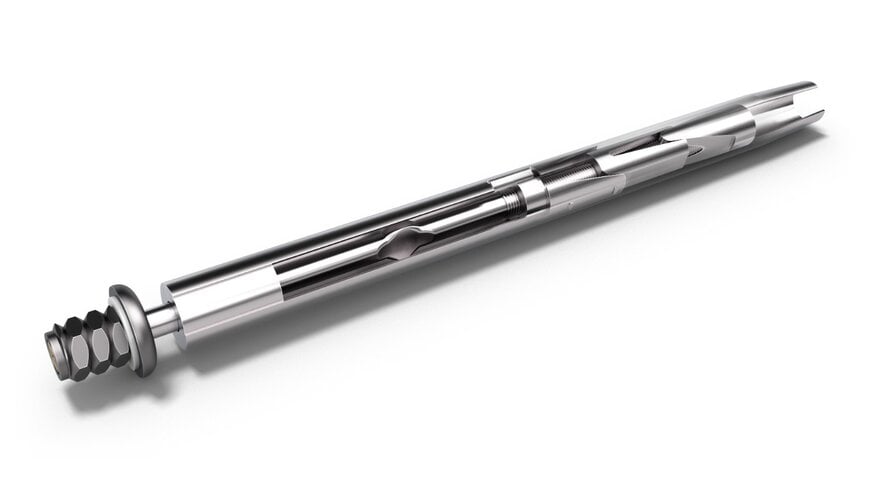
Sandvik D47 Super MDX Bolt delivers 265 kN capacity at 11.5 kg, improving anchorage in fractured and seismic rock with MD/MDX installation equipment.
www.home.sandvik
In deep underground mines, ground support must absorb sudden energy release from seismic events and rockbursts while remaining anchored in rock that is often heavily fractured. Higher bolt capacity alone is not sufficient: if the anchor slips in broken ground, the bolt cannot develop its full strength. Heavier bolts also add to manual handling loads during installation. Sandvik has addressed these requirements with the D47 Super MDX Bolt, a lighter dynamic rock bolt introduced at Ground Support 2026 in Brisbane, Australia.
Capacity and Weight
The Super MDX Bolt uses a new 20 mm round bar and achieves a minimum ultimate tensile capacity of 265 kN. At a length of 2.4 m, it weighs 11.5 kg, which is 800 g less than the equivalent MDX bolt.
Two-Stage Wedge Anchorage in Fractured Rock
Anchorage is provided by a two-stage wedge mechanism that expands up to 68 mm. The larger expansion range is intended to maintain grip in boreholes where fractured rock widens the effective hole diameter. "Higher bolt capacity needs to be matched by reliable anchorage in the rock," said Bradley Darlington, Business Development Specialist Global Products, Ground Support, Sandvik. "That is why we developed the bar, wedges and installation mechanism together."
Toe-Hammering Installation
The bolt is installed with existing MD/MDX equipment and methods and is compatible with existing MD/MDX accessories. A toe-hammering function applies the installation force at the wedge end, pulling the bolt into the borehole instead of pushing it from the nut end. Because the bar is in tension rather than compression during installation, the risk of buckling is reduced, which also allows a thinner tube.
A redesigned stopper combines a paddle on the bar with an internal tube bridge to help arrest bar ejection during shear or overload events. The bolt is xCell Banshee-ready, allowing consumed bolt capacity to be assessed in service.
Testing
Laboratory component and assembly tests were carried out at Sandvik's R&D facility in Heatherbrae, Australia. Underground installation, static and dynamic tests took place at the Sandvik Test Mine in Tampere, Finland, where the bolt withstood a single dynamic impact with 47 kJ of input energy without bar failure.
Additional Context:
This section details technical specifications and competitive benchmarking not included in the original product announcement.
Dynamic, or energy-absorbing, rock bolts are designed to yield under load rather than fail in a brittle manner, so that they dissipate the kinetic energy of ejected rock. Their performance is commonly assessed by drop-weight or momentum-transfer impact tests, in which a mass is dropped onto a bolt sample and the absorbed energy and displacement are measured. Common bolt types used in seismically active mines include cone bolts, D-bolts and expansion-anchored yielding bolts. Results depend strongly on the test method, so impact energies published by different manufacturers are not directly comparable unless the same test protocol is used.
Edited by Evgeny Churilov, Induportals Media - Adapted by AI.
Powered by
Induportals Media Publishing