BHP, Rio Tinto and Caterpillar launch battery-electric haul truck trial in the Pilbara
The trial is showing meaningful progress and reflects an industry effort to tackle the complex challenge of lowering greenhouse gas emissions across large-scale mining operations. www.riotinto.com BHP, Rio Tinto, and Caterpillar have launched a trial of two Cat® 793 XE Early Learner battery-electric haul trucks at a mine-site demonstration in Western Australia’s Pilbara region as part of a joint collaboration. Following three months of initial on-site testing at BHP’s Jimblebar iron ore mine, the trial forms part of an industry effort to lower greenhouse gas emissions across large-scale mining operations. Site Deployment and Performance Verification Prior to their deployment in Western Australia, the battery-electric vehicles underwent safety validation and controlled trials at Caterpillar’s Tucson Proving Ground in the United States. The trucks arrived at the Jimblebar operation late last year to begin verification testing within the Pilbara mining environment. Owing to its high scale and operational intensity, the Pilbara serves as the primary evaluation environment for the heavy haulage platform. The Jimblebar site currently hosts two of the seven total Caterpillar Early Learner battery-electric haul trucks undergoing active testing worldwide. Early-phase testing on-site has logged more than 100 hours of physical operation and exceeded 200 completed test laps. This operational telemetry is being used to evaluate baseline safety metrics, hardware functionality, and machine maintenance profiles while validating core technical assumptions. Infrastructure Evaluation and Dynamic Charging The collaborative mining trial is generating field data to determine technical readiness, localized electrical infrastructure requirements, and commercial feasibility. The scope of the project encompasses testing both high-powered static charging stations and dynamic charging architectures. The upcoming phase of the site trial will focus on evaluating dynamic charging functionality via a specialized energy transfer system. This setup is engineered to transfer electrical power to the trucks to charge the internal battery systems while the vehicles are in motion along the haul road. Western Australia Premier Roger Cook and Mines and Petroleum Minister David Michael inspected the active truck operations alongside corporate representatives from BHP, Rio Tinto, Caterpillar, and dealer partner WesTrac. Additional Context This section details technical specifications not included in the original news release. Ultra-class surface mining haul trucks traditionally rely on high-displacement diesel engines paired with mechanical or AC electric drive transmissions to move high payloads across steep pit ramps. Transitioning these assets to zero-emission operations requires replacing the internal combustion engine with a large-format lithium-ion battery pack and specialized power electronics while maintaining the underlying structural payload capacity. The Cat 793 XE Early Learner configuration leverages a fully electrified drivetrain designed to handle a standard nominal payload capacity of 256 tons (232 tonnes), matching the material throughput performance of standard diesel-powered 793 models. The truck's powertrain leverages a high-voltage architecture integrated with regenerative braking systems. During loaded downhill descents, the electric drive motors function as generators, converting the vehicle's gravitational potential energy into electrical energy. This regenerative current is directed back through traction inverters to recharge the battery system, capturing energy that is normally dissipated as waste heat through traditional grid resistor blown retarders, thereby extending the total operational duty cycle. Powering a fleet of ultra-class electric haul trucks introduces massive electrical load demands that cannot be met solely by stationary plug-in charging stations during shift changes without inducing significant operational downtime. To maintain continuous production cycles, open-pit electrification frameworks deploy dynamic trolley assist lines along fixed uphill haulage ramps. The dynamic charging infrastructure consists of overhead parallel copper catenary wires suspended from structural steel portals along the ramp, energized by dedicated mine-site substations. The haul truck is equipped with a cab-mounted, hydraulically actuated pantograph mechanism. When the vehicle enters the ramp, the operator engages the pantograph to make a physical electrical connection with the overhead lines. The high-voltage direct current (DC) power from the catenary lines feeds directly into the truck’s propulsion system to power the wheel motors up the incline while simultaneously delivering a high-power charge to the onboard battery pack, neutralizing the primary energy drain associated with heavy uphill hauling. Edited by Romila DSilva, Induportals Editor, with AI assistance. www.riotinto.com Powered by Induportals Media Pub
 machineryasia
The trial is showing meaningful progress and reflects an industry effort to tackle the complex challenge of lowering greenhouse gas emissions across large-scale mining operations.
www.riotinto.com
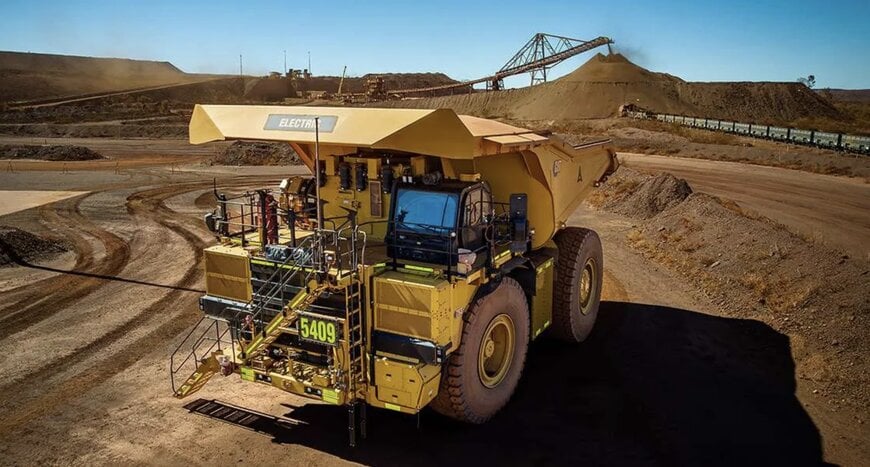
BHP, Rio Tinto, and Caterpillar have launched a trial of two Cat® 793 XE Early Learner battery-electric haul trucks at a mine-site demonstration in Western Australia’s Pilbara region as part of a joint collaboration. Following three months of initial on-site testing at BHP’s Jimblebar iron ore mine, the trial forms part of an industry effort to lower greenhouse gas emissions across large-scale mining operations.
Site Deployment and Performance Verification
Prior to their deployment in Western Australia, the battery-electric vehicles underwent safety validation and controlled trials at Caterpillar’s Tucson Proving Ground in the United States. The trucks arrived at the Jimblebar operation late last year to begin verification testing within the Pilbara mining environment.
Owing to its high scale and operational intensity, the Pilbara serves as the primary evaluation environment for the heavy haulage platform. The Jimblebar site currently hosts two of the seven total Caterpillar Early Learner battery-electric haul trucks undergoing active testing worldwide. Early-phase testing on-site has logged more than 100 hours of physical operation and exceeded 200 completed test laps. This operational telemetry is being used to evaluate baseline safety metrics, hardware functionality, and machine maintenance profiles while validating core technical assumptions.
Infrastructure Evaluation and Dynamic Charging
The collaborative mining trial is generating field data to determine technical readiness, localized electrical infrastructure requirements, and commercial feasibility. The scope of the project encompasses testing both high-powered static charging stations and dynamic charging architectures.
The upcoming phase of the site trial will focus on evaluating dynamic charging functionality via a specialized energy transfer system. This setup is engineered to transfer electrical power to the trucks to charge the internal battery systems while the vehicles are in motion along the haul road. Western Australia Premier Roger Cook and Mines and Petroleum Minister David Michael inspected the active truck operations alongside corporate representatives from BHP, Rio Tinto, Caterpillar, and dealer partner WesTrac.
Additional Context
This section details technical specifications not included in the original news release.
Ultra-class surface mining haul trucks traditionally rely on high-displacement diesel engines paired with mechanical or AC electric drive transmissions to move high payloads across steep pit ramps. Transitioning these assets to zero-emission operations requires replacing the internal combustion engine with a large-format lithium-ion battery pack and specialized power electronics while maintaining the underlying structural payload capacity. The Cat 793 XE Early Learner configuration leverages a fully electrified drivetrain designed to handle a standard nominal payload capacity of 256 tons (232 tonnes), matching the material throughput performance of standard diesel-powered 793 models.
The truck's powertrain leverages a high-voltage architecture integrated with regenerative braking systems. During loaded downhill descents, the electric drive motors function as generators, converting the vehicle's gravitational potential energy into electrical energy. This regenerative current is directed back through traction inverters to recharge the battery system, capturing energy that is normally dissipated as waste heat through traditional grid resistor blown retarders, thereby extending the total operational duty cycle.
Powering a fleet of ultra-class electric haul trucks introduces massive electrical load demands that cannot be met solely by stationary plug-in charging stations during shift changes without inducing significant operational downtime. To maintain continuous production cycles, open-pit electrification frameworks deploy dynamic trolley assist lines along fixed uphill haulage ramps.
The dynamic charging infrastructure consists of overhead parallel copper catenary wires suspended from structural steel portals along the ramp, energized by dedicated mine-site substations. The haul truck is equipped with a cab-mounted, hydraulically actuated pantograph mechanism. When the vehicle enters the ramp, the operator engages the pantograph to make a physical electrical connection with the overhead lines. The high-voltage direct current (DC) power from the catenary lines feeds directly into the truck’s propulsion system to power the wheel motors up the incline while simultaneously delivering a high-power charge to the onboard battery pack, neutralizing the primary energy drain associated with heavy uphill hauling.
Edited by Romila DSilva, Induportals Editor, with AI assistance.
www.riotinto.com
Powered by
Induportals Media Publishing