Volvo CE partners with Que Mekong in Cambodia
The dealership supports Cambodia's Vision 2050 infrastructure goals with localized aftermarket services and electric construction machinery. www.volvoce.com Volvo CE and Que Mekong management teams pose alongside Volvo CE machines at the dealer inauguration in Phnom Penh, Cambodia. Volvo Construction Equipment (Volvo CE) has officially appointed Que Mekong Co., Ltd as its national distributor in Cambodia. The partnership was commemorated on October 23 during a dealer inauguration and customer roadshow at The Premium Palace in Phnom Penh. Attended by 150 guests—including Her Excellency LCT Kha Leng, Secretary of State at the Ministry of Commerce, and Neak Oknha Ly Kunthai, President of the Cambodia Confederation of Investors Association—the event showcased Volvo CE’s next-generation excavators and compaction equipment to the local market. Aligning with Cambodia's Vision 2050 The Cambodian government's 7th National Strategic Development Plan 2024–2028 is driving heavy investment into roads, irrigation systems, and transport infrastructure. To meet the demands of these large-scale projects, the Volvo CE and Que Mekong alliance will supply the region with a robust portfolio of wheel loaders, articulated haulers, excavators, and compactors. By establishing a central base in Phnom Penh with strategic satellite branches, Que Mekong aims to provide rapid on-site service and spare parts delivery to contractors operating in both urban centers and remote rural development zones. Enhancing aftermarket support and electrification A primary focus of the new dealership is maximizing machine uptime through localized technical expertise. Wilson Shee, Head of Market Cambodia for Volvo CE, emphasized that the partnership relies on training local technicians to deliver highly efficient on-site maintenance. Furthermore, as Cambodia pursues green growth initiatives, the introduction of Volvo CE’s battery-electric construction machines provides contractors with zero-emission solutions for urban infrastructure and eco-tourism development, aligning heavy earthmoving operations with national sustainability targets. Additional Context: Thermal management in battery-electric heavy machinery This section details electrical engineering principles for heavy equipment not included in the original press release. While the transition to battery-electric construction equipment eliminates diesel emissions, operating high-voltage machinery in tropical climates like Cambodia presents distinct engineering challenges. Unlike passenger EVs, heavy excavators and wheel loaders experience continuous, high-torque duty cycles that generate massive internal heat. To prevent lithium-ion battery packs from exceeding their optimal operating temperature window (typically 15°C to 35°C) and triggering thermal throttling, these machines rely on active liquid-cooling systems. These systems circulate a dielectric glycol-water mixture through micro-channels integrated directly between the battery modules. Maintaining strict thermal equilibrium is critical; if the temperature differential across individual battery cells exceeds just a few degrees during heavy earthmoving operations, the pack's overall capacity degrades rapidly, severely reducing the machine's operational runtime and peak hydraulic breakout force. Edited by an industrial journalist, Lekshman Ramdas, with AI assistance. www.volvoce.com Powered by Induportals Media Publishing
 machineryasia

The dealership supports Cambodia's Vision 2050 infrastructure goals with localized aftermarket services and electric construction machinery.
www.volvoce.com
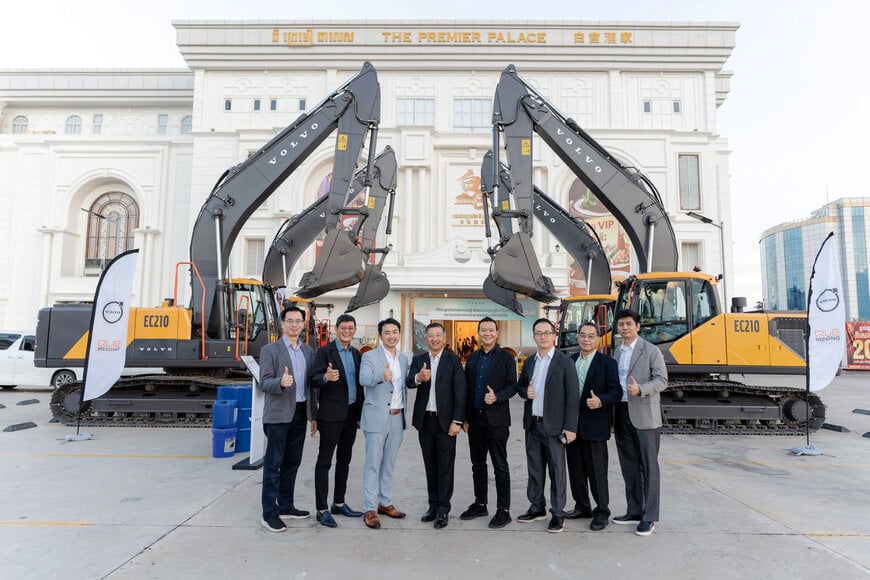
Volvo CE and Que Mekong management teams pose alongside Volvo CE machines at the dealer inauguration in Phnom Penh, Cambodia.
Volvo Construction Equipment (Volvo CE) has officially appointed Que Mekong Co., Ltd as its national distributor in Cambodia. The partnership was commemorated on October 23 during a dealer inauguration and customer roadshow at The Premium Palace in Phnom Penh. Attended by 150 guests—including Her Excellency LCT Kha Leng, Secretary of State at the Ministry of Commerce, and Neak Oknha Ly Kunthai, President of the Cambodia Confederation of Investors Association—the event showcased Volvo CE’s next-generation excavators and compaction equipment to the local market.
Aligning with Cambodia's Vision 2050
The Cambodian government's 7th National Strategic Development Plan 2024–2028 is driving heavy investment into roads, irrigation systems, and transport infrastructure. To meet the demands of these large-scale projects, the Volvo CE and Que Mekong alliance will supply the region with a robust portfolio of wheel loaders, articulated haulers, excavators, and compactors. By establishing a central base in Phnom Penh with strategic satellite branches, Que Mekong aims to provide rapid on-site service and spare parts delivery to contractors operating in both urban centers and remote rural development zones.
Enhancing aftermarket support and electrification
A primary focus of the new dealership is maximizing machine uptime through localized technical expertise. Wilson Shee, Head of Market Cambodia for Volvo CE, emphasized that the partnership relies on training local technicians to deliver highly efficient on-site maintenance. Furthermore, as Cambodia pursues green growth initiatives, the introduction of Volvo CE’s battery-electric construction machines provides contractors with zero-emission solutions for urban infrastructure and eco-tourism development, aligning heavy earthmoving operations with national sustainability targets.
Additional Context: Thermal management in battery-electric heavy machinery
This section details electrical engineering principles for heavy equipment not included in the original press release.
While the transition to battery-electric construction equipment eliminates diesel emissions, operating high-voltage machinery in tropical climates like Cambodia presents distinct engineering challenges. Unlike passenger EVs, heavy excavators and wheel loaders experience continuous, high-torque duty cycles that generate massive internal heat. To prevent lithium-ion battery packs from exceeding their optimal operating temperature window (typically 15°C to 35°C) and triggering thermal throttling, these machines rely on active liquid-cooling systems. These systems circulate a dielectric glycol-water mixture through micro-channels integrated directly between the battery modules. Maintaining strict thermal equilibrium is critical; if the temperature differential across individual battery cells exceeds just a few degrees during heavy earthmoving operations, the pack's overall capacity degrades rapidly, severely reducing the machine's operational runtime and peak hydraulic breakout force.
Edited by an industrial journalist, Lekshman Ramdas, with AI assistance.
www.volvoce.com
Powered by
Induportals Media Publishing