Tower Crane Roof Assembly for High-Altitude Urban Renovation
The contracted construction company San Jose deployed an specialized flat-top tower crane to complete the structural modernization and viewing platform extension of the Torre del Agua. www.liebherr.com Application area: High-altitude construction and structural rehabilitation Industry sector: Civil engineering and urban infrastructure The public development entity Expo Zaragoza Empresarial has initiated a comprehensive modernization and extension program for the Torre del Agua in Zaragoza, Spain. Executed by the main contractor San Jose, the project involves technical refurbishment, regulatory adaptation, and the integration of a new 360-degree glass viewing platform on top of the 76-meter-high architectural landmark. To execute the structural lifting operations required for this project, the contractor deployed a specialized flat-top tower crane anchored directly to the building's roof structure. The setup necessitated an auxiliary high-capacity mobile crane to perform the complex high-altitude assembly. Structural Constraints and Vertical Height Limitations in Historic Urban Spaces Working on historical or unique architectural landmarks presents significant geometric and load-bearing constraints. The iconic water-drop profile of the Torre del Agua requires that any material handling system operate within narrow physical parameters to avoid damaging the existing facade. A major technical limitation of the project was a strict regulatory and structural ceiling, specifying that the total height of the assembly mechanism must not exceed 100 meters. Furthermore, standard ground-based crane configurations were unfeasible due to the required working radii, meaning the tower crane had to be positioned directly on the roof at an elevation of 80 meters. This layout created a critical engineering challenge: the roof structure could not support an arbitrary static load, requiring the crane base to be precisely aligned with specific, load-bearing vertical support pillars capable of absorbing the structural forces. Flat-Top Kinematics and High-Capacity Mobile Pre-Assembly To meet the 100-meter height ceiling, the technical solution chosen was a flat-top tower crane configuration from the rental fleet of Gruas Cerezo. Unlike conventional hammerhead cranes, flat-top models eliminate the overhead gantry and cat-head structure, drastically reducing the required vertical clearance while maintaining lifting capacity. The assembly of this tower crane on the roof was executed using a heavy-duty 700-tonne mobile crane provided by Gruas El Portillo. A joint engineering assessment concluded that a mobile crane equipped with a hydraulically adjustable luffing jib was necessary to manage the required working angles. The technical parameters of the pre-assembly phase involved: Operating at a vertical working height of 113 meters to clear the building's crown. Handling a structural component weight of 6 tonnes. Maintaining a precise horizontal working radius of 54 meters during the placement of the tower crane base. This specific mechanical pairing allowed the installation team to anchor the tower crane securely onto a single designated vertical pillar on the roof, conforming to the structural safety limits of the building. Upgrading Infrastructure and Integrating Modern Safety Codes Once assembled on the roof, the flat-top crane became the central component for executing the structural changes on the tower. The scope of work encompasses updating the building's infrastructure to meet evolving regulatory building codes established since the structure's initial completion for Expo 2008. Beyond structural reinforcement, the lifting setup manages materials for constructing a new panoramic 360-degree glazed viewing deck, upgrading the upper-level catering facilities, and reshaping the ground floor into multi-functional public spaces. Enhanced Load Distribution and Site Setup Efficiency By anchoring the flat-top crane directly onto the load-bearing vertical pillar of the roof, the construction team minimized the physical footprint of the machinery at ground level. This layout choice was essential for preserving the surrounding public spaces and infrastructure around the landmark. The flat-top design allowed the crane to operate efficiently within the 100-meter restricted airspace, providing the necessary hook height to install the heavy glass panels and structural steel elements for the new viewing platform. Additionally, utilizing a 700-tonne mobile crane with a hydraulically adjustable jib eliminated the need for complex, time-consuming ground ballast configurations or secondary lifting towers. This technical approach streamlined the initial assembly process and ensured precise positioning of the heavy components without overloading the building’s roof structure. Edited by Sucithra Mani, Induportals editor – adapted by AI. www.liebherr.com Powered by Induportals Media Publishing
 machineryasia
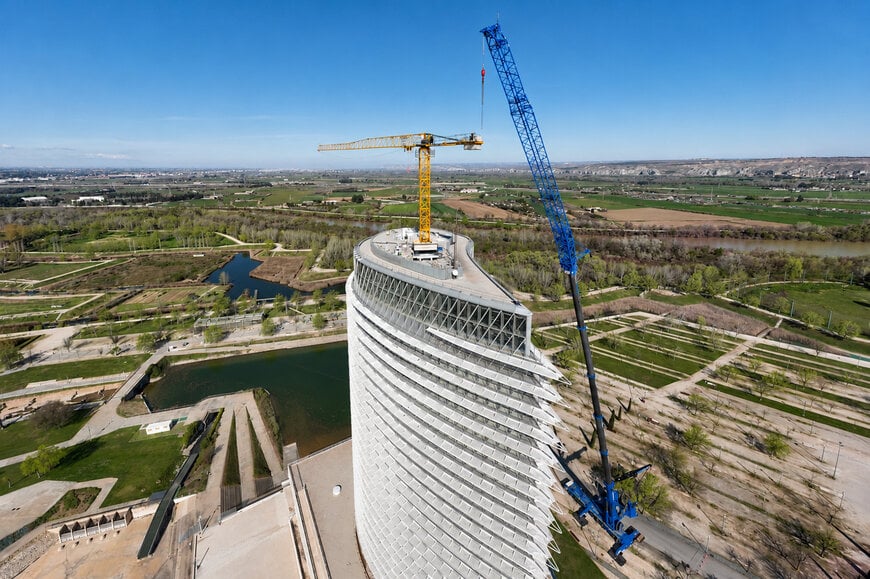
The contracted construction company San Jose deployed an specialized flat-top tower crane to complete the structural modernization and viewing platform extension of the Torre del Agua.
www.liebherr.com
Application area: High-altitude construction and structural rehabilitation
Industry sector: Civil engineering and urban infrastructure
The public development entity Expo Zaragoza Empresarial has initiated a comprehensive modernization and extension program for the Torre del Agua in Zaragoza, Spain. Executed by the main contractor San Jose, the project involves technical refurbishment, regulatory adaptation, and the integration of a new 360-degree glass viewing platform on top of the 76-meter-high architectural landmark. To execute the structural lifting operations required for this project, the contractor deployed a specialized flat-top tower crane anchored directly to the building's roof structure. The setup necessitated an auxiliary high-capacity mobile crane to perform the complex high-altitude assembly.
Structural Constraints and Vertical Height Limitations in Historic Urban Spaces
Working on historical or unique architectural landmarks presents significant geometric and load-bearing constraints. The iconic water-drop profile of the Torre del Agua requires that any material handling system operate within narrow physical parameters to avoid damaging the existing facade. A major technical limitation of the project was a strict regulatory and structural ceiling, specifying that the total height of the assembly mechanism must not exceed 100 meters.
Furthermore, standard ground-based crane configurations were unfeasible due to the required working radii, meaning the tower crane had to be positioned directly on the roof at an elevation of 80 meters. This layout created a critical engineering challenge: the roof structure could not support an arbitrary static load, requiring the crane base to be precisely aligned with specific, load-bearing vertical support pillars capable of absorbing the structural forces.
Flat-Top Kinematics and High-Capacity Mobile Pre-Assembly
To meet the 100-meter height ceiling, the technical solution chosen was a flat-top tower crane configuration from the rental fleet of Gruas Cerezo. Unlike conventional hammerhead cranes, flat-top models eliminate the overhead gantry and cat-head structure, drastically reducing the required vertical clearance while maintaining lifting capacity.
The assembly of this tower crane on the roof was executed using a heavy-duty 700-tonne mobile crane provided by Gruas El Portillo. A joint engineering assessment concluded that a mobile crane equipped with a hydraulically adjustable luffing jib was necessary to manage the required working angles. The technical parameters of the pre-assembly phase involved:
- Operating at a vertical working height of 113 meters to clear the building's crown.
- Handling a structural component weight of 6 tonnes.
- Maintaining a precise horizontal working radius of 54 meters during the placement of the tower crane base.
This specific mechanical pairing allowed the installation team to anchor the tower crane securely onto a single designated vertical pillar on the roof, conforming to the structural safety limits of the building.
Upgrading Infrastructure and Integrating Modern Safety Codes
Once assembled on the roof, the flat-top crane became the central component for executing the structural changes on the tower. The scope of work encompasses updating the building's infrastructure to meet evolving regulatory building codes established since the structure's initial completion for Expo 2008. Beyond structural reinforcement, the lifting setup manages materials for constructing a new panoramic 360-degree glazed viewing deck, upgrading the upper-level catering facilities, and reshaping the ground floor into multi-functional public spaces.
Enhanced Load Distribution and Site Setup Efficiency
By anchoring the flat-top crane directly onto the load-bearing vertical pillar of the roof, the construction team minimized the physical footprint of the machinery at ground level. This layout choice was essential for preserving the surrounding public spaces and infrastructure around the landmark.
The flat-top design allowed the crane to operate efficiently within the 100-meter restricted airspace, providing the necessary hook height to install the heavy glass panels and structural steel elements for the new viewing platform. Additionally, utilizing a 700-tonne mobile crane with a hydraulically adjustable jib eliminated the need for complex, time-consuming ground ballast configurations or secondary lifting towers. This technical approach streamlined the initial assembly process and ensured precise positioning of the heavy components without overloading the building’s roof structure.
Edited by Sucithra Mani, Induportals editor – adapted by AI.
www.liebherr.com
Upgrading Infrastructure and Integrating Modern Safety Codes
Once assembled on the roof, the flat-top crane became the central component for executing the structural changes on the tower. The scope of work encompasses updating the building's infrastructure to meet evolving regulatory building codes established since the structure's initial completion for Expo 2008. Beyond structural reinforcement, the lifting setup manages materials for constructing a new panoramic 360-degree glazed viewing deck, upgrading the upper-level catering facilities, and reshaping the ground floor into multi-functional public spaces.
Enhanced Load Distribution and Site Setup Efficiency
By anchoring the flat-top crane directly onto the load-bearing vertical pillar of the roof, the construction team minimized the physical footprint of the machinery at ground level. This layout choice was essential for preserving the surrounding public spaces and infrastructure around the landmark.
The flat-top design allowed the crane to operate efficiently within the 100-meter restricted airspace, providing the necessary hook height to install the heavy glass panels and structural steel elements for the new viewing platform. Additionally, utilizing a 700-tonne mobile crane with a hydraulically adjustable jib eliminated the need for complex, time-consuming ground ballast configurations or secondary lifting towers. This technical approach streamlined the initial assembly process and ensured precise positioning of the heavy components without overloading the building’s roof structure.
Edited by Sucithra Mani, Induportals editor – adapted by AI.
www.liebherr.com
Powered by
Induportals Media Publishing