Tower and all-terrain cranes build Italian milling facility
Gruppo Mitri Costruzioni deploys Potain and Grove cranes to construct a €30 million agri-food complex in Italy. www.manitowoc.com In Ripamolisani, southern Italy, a €30 million (approximately ₹270 crore) milling facility is currently under construction for Mulino Caputo. Scheduled for completion in 2030, the industrial complex will feature high-capacity storage silos, advanced raw material processing lines, and dedicated logistics facilities to support the regional agri-food sector. To manage the diverse structural requirements of this extensive project, contractor Gruppo Mitri Costruzioni (M.B.C.) implemented a phased lifting strategy utilizing specialized self-erecting, topless tower, and all-terrain cranes. Overcoming site constraints with self-erecting cranes During the initial phases of site preparation and early construction, optimizing available ground space and accelerating jobsite setup were critical priorities. The contractor deployed a Potain Evy 30-23 self-erecting crane to manage these requirements. Featuring a maximum lifting capacity of 4 tonnes and a 30-metre jib, the unit provided immediate lifting capabilities without requiring extensive foundation work. Its compact dimensions and rapid deployment mechanism allowed the engineering team to maintain flexibility in a restricted footprint, maximizing early-stage productivity before the primary structural work began. Heavy lifting and structural assembly As the project transitioned to heavy structural phases, M.B.C. introduced a Potain MDT 259 J12 topless tower crane to handle large process equipment and structural components weighing up to 12 tonnes. The tower crane was erected with a 60-metre jib and a hook height of 70 metres. To assemble this high-capacity unit, the contractor utilized a Grove GMK5150L-1 all-terrain crane. Equipped with a 60-metre main boom and a 150-tonne maximum capacity, the all-terrain mobile unit delivered the necessary stability, maneuverability, and precision to safely position the topless crane segments at height. Coordinated lifting strategies and operational efficiency The integration of different crane topologies allowed the contractor to match lifting hardware directly to specific project phases. Devis Mitri, general manager of M.B.C., indicated that coordinating flexible early-stage equipment with heavy-duty structural cranes successfully met the site's shifting operational demands. This layered approach to lifting technology improves overall productivity and operational sustainability on large-scale infrastructure projects. Furthermore, ongoing technical assistance and local service from the equipment manufacturer's Italian team have maximized machinery uptime, ensuring the complex remains on schedule. Additional Context: Topless architecture and deployment logistics In large-scale industrial construction, the shift toward topless (flat-top) tower cranes resolves significant logistical bottlenecks. Traditional hammerhead cranes utilize pendant lines (tie-bars) to support the jib, which increases the overall height profile and complicates operations when multiple cranes must overlap on a crowded jobsite. Topless designs eliminate these tie-bars, allowing for a lower clearance envelope and safer multi-crane coordination. Furthermore, their modular jib sections can be pre-assembled on the ground and lifted directly into place by a mobile assist crane, which drastically reduces airborne assembly time. Combining this architecture with agile all-terrain mobile cranes allows contractors to erect massive lifting infrastructure within tight timeframes and confined spaces, minimizing disruption to surrounding operations. Edited by Lekshman Ramdas, InduPortals editor – adapted by AI. www.manitowoc.com Powered by Induportals Media Publishing
 machineryasia
Gruppo Mitri Costruzioni deploys Potain and Grove cranes to construct a €30 million agri-food complex in Italy.
www.manitowoc.com
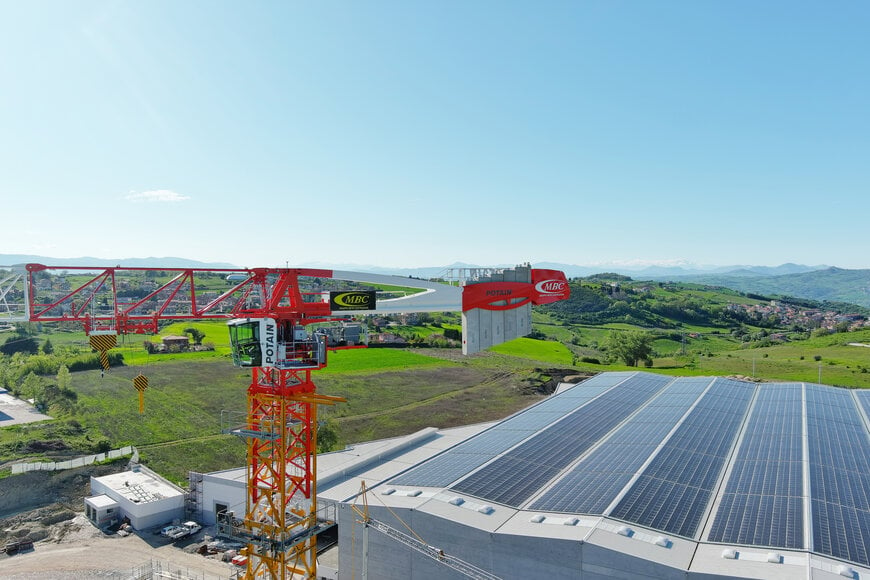
In Ripamolisani, southern Italy, a €30 million (approximately ₹270 crore) milling facility is currently under construction for Mulino Caputo. Scheduled for completion in 2030, the industrial complex will feature high-capacity storage silos, advanced raw material processing lines, and dedicated logistics facilities to support the regional agri-food sector. To manage the diverse structural requirements of this extensive project, contractor Gruppo Mitri Costruzioni (M.B.C.) implemented a phased lifting strategy utilizing specialized self-erecting, topless tower, and all-terrain cranes.
Overcoming site constraints with self-erecting cranes
During the initial phases of site preparation and early construction, optimizing available ground space and accelerating jobsite setup were critical priorities. The contractor deployed a Potain Evy 30-23 self-erecting crane to manage these requirements. Featuring a maximum lifting capacity of 4 tonnes and a 30-metre jib, the unit provided immediate lifting capabilities without requiring extensive foundation work. Its compact dimensions and rapid deployment mechanism allowed the engineering team to maintain flexibility in a restricted footprint, maximizing early-stage productivity before the primary structural work began.
Heavy lifting and structural assembly
As the project transitioned to heavy structural phases, M.B.C. introduced a Potain MDT 259 J12 topless tower crane to handle large process equipment and structural components weighing up to 12 tonnes. The tower crane was erected with a 60-metre jib and a hook height of 70 metres. To assemble this high-capacity unit, the contractor utilized a Grove GMK5150L-1 all-terrain crane. Equipped with a 60-metre main boom and a 150-tonne maximum capacity, the all-terrain mobile unit delivered the necessary stability, maneuverability, and precision to safely position the topless crane segments at height.
Coordinated lifting strategies and operational efficiency
The integration of different crane topologies allowed the contractor to match lifting hardware directly to specific project phases. Devis Mitri, general manager of M.B.C., indicated that coordinating flexible early-stage equipment with heavy-duty structural cranes successfully met the site's shifting operational demands. This layered approach to lifting technology improves overall productivity and operational sustainability on large-scale infrastructure projects. Furthermore, ongoing technical assistance and local service from the equipment manufacturer's Italian team have maximized machinery uptime, ensuring the complex remains on schedule.
Additional Context: Topless architecture and deployment logistics
In large-scale industrial construction, the shift toward topless (flat-top) tower cranes resolves significant logistical bottlenecks. Traditional hammerhead cranes utilize pendant lines (tie-bars) to support the jib, which increases the overall height profile and complicates operations when multiple cranes must overlap on a crowded jobsite. Topless designs eliminate these tie-bars, allowing for a lower clearance envelope and safer multi-crane coordination. Furthermore, their modular jib sections can be pre-assembled on the ground and lifted directly into place by a mobile assist crane, which drastically reduces airborne assembly time. Combining this architecture with agile all-terrain mobile cranes allows contractors to erect massive lifting infrastructure within tight timeframes and confined spaces, minimizing disruption to surrounding operations.
Edited by Lekshman Ramdas, InduPortals editor – adapted by AI.
www.manitowoc.com
Powered by
Induportals Media Publishing