Topless Tower Crane Control Systems for Urban Construction
Manitowoc introduces the Potain MDT 99e crane with the CCS Evolution control system to solve space constraints and commissioning delays on urban jobsites. www.manitowoc.com High-density residential and commercial construction projects face severe spatial limitations, restricted airspace, and variable site power availability. To address these operational constraints while meeting updated European structural safety regulations, Manitowoc has developed the Potain MDT 99e topless tower crane, the first unit in the MDT City range to integrate the CCS Evolution control architecture. Overcoming Spatial and Electrical Constraints in Urban Lifting Modern urban construction sites frequently operate with multiple overlapping cranes in tight footprints where every square meter of ground and air space is restricted. Traditional cathead tower cranes require significant vertical clearance between jibs to prevent structural interference with tie bars. Topless tower cranes eliminate the cathead assembly, reducing the vertical height difference required between adjacent cranes and allowing closer installation on congested city sites. Beyond physical space limitations, urban jobsites often contend with fluctuating electrical infrastructure and high operator turnover across rental fleets. The Potain MDT 99e addresses these production challenges by combining a compact structural footprint with automated power management and customizable electronic controls. As stated by Thibaut Le Besnerais, vice president of marketing and product development at Potain, contractors face continuous challenges from spatial constraints in urban environments, requiring a balance of compact geometry, lifting capacity, and rapid installation alongside updated regulatory compliance. CCS Evolution Architecture and Control Strategy The primary engineering development on the MDT 99e is the introduction of the CCS Evolution control system, an advancement of the established Potain Crane Control System. In tower crane operations, control loops govern slewing, trolleying, and hoisting drives to minimize load sway and positioning error. CCS Evolution refines these motion profiles to increase precision and smooth out mechanical transitions during multi-axis movements. From a maintenance and commissioning perspective, traditional crane setup requires manual calibration of limit switches and load parameters. CCS Evolution replaces complex setup procedures with an integrated touchscreen and graphical user interface. Service technicians use this interface to execute calibration routines and fault diagnostics directly from the cab, reducing initial commissioning duration and minimizing unplanned maintenance downtime throughout the service life of the equipment. Within the optional Ultra View cab, operators can store and recall personalized control sensitivity settings, which reduces setup time during shift changes and lowers the probability of operator error in multi-user rental fleet environments. Software Integration and Variable Frequency Drive Mechanics To maximize lifting productivity within a 5 t structural envelope, the MDT 99e utilizes a permanent four-fall reeving configuration driven by a 25 LVF 13 Optima variable frequency hoist winch. Permanent four-fall reeving eliminates the mechanical downtime required to manually re-reeve the hook block between two-fall and four-fall configurations when switching between light, high-speed lifts and heavy loads. The variable frequency drive works in tandem with Potain Plus software, which dynamically adjusts hoist and trolley speeds based on the actual mass on the hook, permitting higher line speeds for loads below the maximum rated capacity. To prevent overload on weak or unstable urban electrical grids, the integrated Power Control system monitors incoming supply and modulates crane power draw, allowing lifting operations to continue under variable voltage or limited generator capacity. For multi-crane urban deployments, the crane incorporates the Top Site anti-collision system to monitor slewing angles and trolley positions relative to site boundaries and neighboring structures. Technical Specifications and Mast Compatibility The Potain MDT 99e provides a maximum lifting capacity of 5 t and a maximum horizontal reach of 55 m. At the 55 m jib end, the crane maintains a tip capacity of 1.2 t. For structural integration, the crane is compatible with standard Potain 1.2 m K-mast and L-mast sections. This cross-compatibility allows equipment owners and rental fleets to utilize existing mast inventory without investing in proprietary tower sections, lowering the total cost of ownership. Real-World Applications and Logistics Optimization In practical deployment across residential and urban commercial workflows, tower crane erection and dismantling represent major logistical bottlenecks. The MDT 99e incorporates direct base access to both the jib and counter-jib to simplify rigging work for assembly crews,
 machineryasia

Manitowoc introduces the Potain MDT 99e crane with the CCS Evolution control system to solve space constraints and commissioning delays on urban jobsites.
www.manitowoc.com
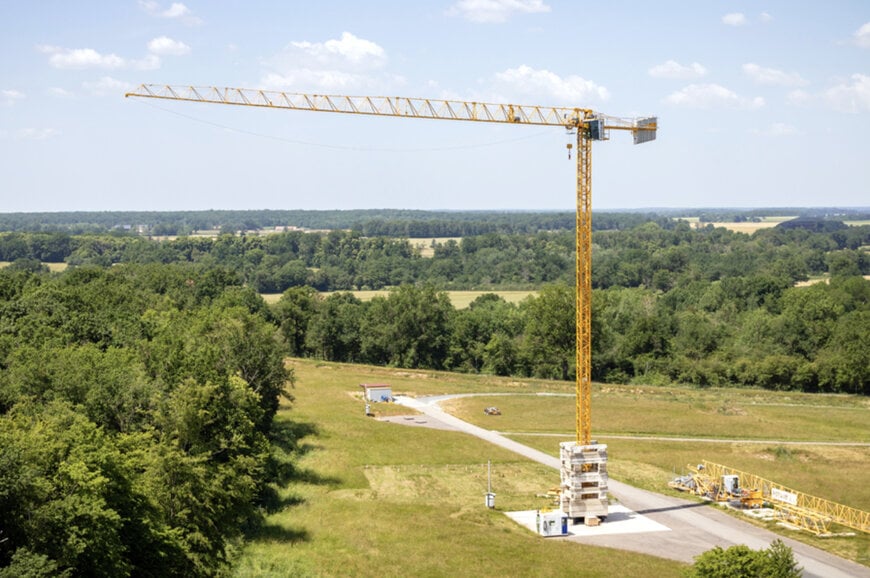
High-density residential and commercial construction projects face severe spatial limitations, restricted airspace, and variable site power availability. To address these operational constraints while meeting updated European structural safety regulations, Manitowoc has developed the Potain MDT 99e topless tower crane, the first unit in the MDT City range to integrate the CCS Evolution control architecture.
Overcoming Spatial and Electrical Constraints in Urban Lifting
Modern urban construction sites frequently operate with multiple overlapping cranes in tight footprints where every square meter of ground and air space is restricted. Traditional cathead tower cranes require significant vertical clearance between jibs to prevent structural interference with tie bars. Topless tower cranes eliminate the cathead assembly, reducing the vertical height difference required between adjacent cranes and allowing closer installation on congested city sites.
Beyond physical space limitations, urban jobsites often contend with fluctuating electrical infrastructure and high operator turnover across rental fleets. The Potain MDT 99e addresses these production challenges by combining a compact structural footprint with automated power management and customizable electronic controls. As stated by Thibaut Le Besnerais, vice president of marketing and product development at Potain, contractors face continuous challenges from spatial constraints in urban environments, requiring a balance of compact geometry, lifting capacity, and rapid installation alongside updated regulatory compliance.
CCS Evolution Architecture and Control Strategy
The primary engineering development on the MDT 99e is the introduction of the CCS Evolution control system, an advancement of the established Potain Crane Control System. In tower crane operations, control loops govern slewing, trolleying, and hoisting drives to minimize load sway and positioning error. CCS Evolution refines these motion profiles to increase precision and smooth out mechanical transitions during multi-axis movements.
From a maintenance and commissioning perspective, traditional crane setup requires manual calibration of limit switches and load parameters. CCS Evolution replaces complex setup procedures with an integrated touchscreen and graphical user interface. Service technicians use this interface to execute calibration routines and fault diagnostics directly from the cab, reducing initial commissioning duration and minimizing unplanned maintenance downtime throughout the service life of the equipment. Within the optional Ultra View cab, operators can store and recall personalized control sensitivity settings, which reduces setup time during shift changes and lowers the probability of operator error in multi-user rental fleet environments.
Software Integration and Variable Frequency Drive Mechanics
To maximize lifting productivity within a 5 t structural envelope, the MDT 99e utilizes a permanent four-fall reeving configuration driven by a 25 LVF 13 Optima variable frequency hoist winch. Permanent four-fall reeving eliminates the mechanical downtime required to manually re-reeve the hook block between two-fall and four-fall configurations when switching between light, high-speed lifts and heavy loads.
The variable frequency drive works in tandem with Potain Plus software, which dynamically adjusts hoist and trolley speeds based on the actual mass on the hook, permitting higher line speeds for loads below the maximum rated capacity. To prevent overload on weak or unstable urban electrical grids, the integrated Power Control system monitors incoming supply and modulates crane power draw, allowing lifting operations to continue under variable voltage or limited generator capacity. For multi-crane urban deployments, the crane incorporates the Top Site anti-collision system to monitor slewing angles and trolley positions relative to site boundaries and neighboring structures.
Technical Specifications and Mast Compatibility
The Potain MDT 99e provides a maximum lifting capacity of 5 t and a maximum horizontal reach of 55 m. At the 55 m jib end, the crane maintains a tip capacity of 1.2 t.
For structural integration, the crane is compatible with standard Potain 1.2 m K-mast and L-mast sections. This cross-compatibility allows equipment owners and rental fleets to utilize existing mast inventory without investing in proprietary tower sections, lowering the total cost of ownership.
Real-World Applications and Logistics Optimization
In practical deployment across residential and urban commercial workflows, tower crane erection and dismantling represent major logistical bottlenecks. The MDT 99e incorporates direct base access to both the jib and counter-jib to simplify rigging work for assembly crews, paired with component dimensions optimized for road transport.
Recognizing that installation methods vary by geography and site accessibility, Manitowoc offers the MDT 99e in two distinct structural variants. The first configuration is engineered specifically for ground-based mobile crane assembly in congested urban streets. The second variant is structurally segmented by weight and balance points for contractors who routinely execute crane erection via helicopter in inaccessible or high-density locations. Furthermore, the crane is engineered for full compliance with the EN 14439:2025 European design standard, ensuring fleet readiness for stricter regulatory frameworks.
Additional Context:
This section details technical specifications and competitive benchmarking not included in the original product announcement.
The transition to the EN 14439:2025 European standard (published by CEN to supersede EN 14439:2006+A2:2009) introduces updated safety and structural verification requirements for construction tower cranes. Key regulatory drivers in the 2025 revision include refined wind load calculations, updated out-of-service storm wind resistance criteria (C25/D25 and C50/D50 classifications), and stricter safety protocols for climbing systems and operator access. Designing the MDT 99e natively around EN 14439:2025 allows fleet operators to meet European Machinery Directive conformity requirements without structural retrofits.
Within Potain's own product evolution, the MDT 99e occupies the compact urban segment alongside models such as the Potain MCT 88 and the larger Potain MDT 109, while succeeding legacy city models like the Potain MDT 98. Compared to the MCT 88, which also features a 5 t maximum capacity but is limited to a 52 m maximum radius and a 1.15 t tip load, the MDT 99e extends horizontal reach by 3 m to 55 m and increases jib-end capacity to 1.2 t. Compared to the 6 t capacity Potain MDT 109 (55 m reach, 1.35 t tip capacity), the MDT 99e provides an entry-level 5 t alternative utilizing the narrower 1.2 m mast footprint.
In the broader European tower crane sector, an established benchmark in the 5 t topless urban category is the Liebherr 85 EC-B 5. Both cranes target tight urban jobsites with a 5 t maximum lifting capacity and a flat-top architecture designed to simplify multi-crane site planning. While the MDT 99e achieves a 55 m maximum radius with a 1.2 t tip load using CCS Evolution and Potain Plus software, competing 5 t flat-top systems typically operate across 50 m to 55 m radii using comparable micromove and variable-frequency load-speed optimization drives.
Edited by Sucithra Mani, Induportals editor – adapted by AI.
www.manitowoc.com
Powered by
Induportals Media Publishing