The Air Inside Industrial Control Rooms Is More Vulnerable Than It Looks
Your control room feels like a sealed fortress, built to keep volatile processes outside from reaching anyone inside. But the air inside industrial control rooms moves constantly through doors, cable entries and HVAC ducts. Positive pressurization and layered filtration decide whether that air stays within the fortress or becomes an opening for whatever drifts past […] The post The Air Inside Industrial Control Rooms Is More Vulnerable Than It Looks appeared first on World Construction Today.
 machineryasia
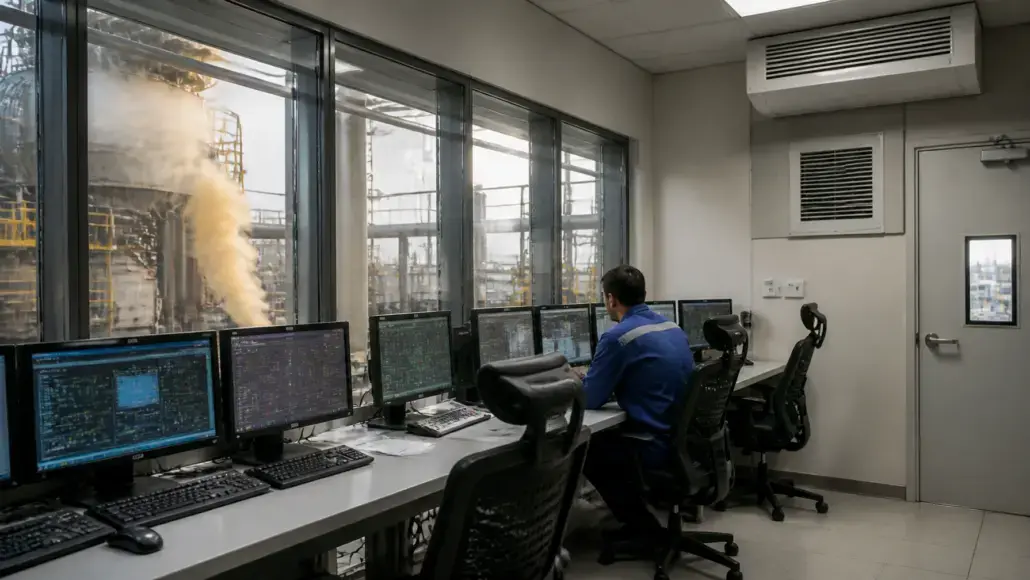
Your control room feels like a sealed fortress, built to keep volatile processes outside from reaching anyone inside. But the air inside industrial control rooms moves constantly through doors, cable entries and HVAC ducts. Positive pressurization and layered filtration decide whether that air stays within the fortress or becomes an opening for whatever drifts past the perimeter.
How Hazardous Air Can Infiltrate Your Control Room
Leaks and process releases at a volatile facility can push toxic and flammable gases, along with airborne dust, into the atmosphere surrounding your control room. Even a well-sealed structure has points where contaminated air can get in, including doors, cable penetrations, construction gaps and HVAC intakes.
These entry points matter more in a control room than almost anywhere else on-site, since the space is designed to house the personnel and electronic systems that keep an entire facility running safely. A single compromised seal or an intake placed too close to a release point can turn a protective space into a liability during an upset condition.
Why Detection and Ventilation Must Work Together
A publication from the Occupational Safety and Health Administration, reported by the American Industrial Hygiene Association, revisited a 2019 hydrogen sulfide release at an oil and gas facility in Texas. Investigators found that detectors never communicated with the alarm system, since several units had been left in testing mode while others simply failed to transmit a signal into the control room.
That finding points to a lesson beyond one incident, since detection hardware only protects a facility when it’s configured correctly, tested routinely and wired into a working alarm system. Your control room is only as protected as the systems that keep contaminated air out and flag when something goes wrong. That protection starts with positive pressurization, designed to keep hazardous air from reaching the room at all.
How Positive Pressurization Keeps Toxic and Flammable Air Out
A positive pressure unit first draws in outdoor air through its filters, then pushes that filtered air into the control room, which is designed to remain above the surrounding pressure. According to Mideco, an industrial dust control company whose pressurization systems help protect workers and equipment, when indoor pressure remains above ambient, the higher pressure physically blocks contaminant ingress because leakage flows outward through gaps and penetrations rather than inward. This means that “unfiltered plant air cannot passively enter,” the company notes.
This design means that every door opening and cable entry can serve as an exit point for clean air rather than an entry point for contamination, provided the pressure differential remains steady. Losing that differential, even briefly, can let hazardous air drift back toward the people and equipment the system is meant to protect.
Why Pressure Monitoring Matters
Maintaining that pressure differential takes more than installing the unit and walking away. Fan performance drifts over time and filters load with particulate, while door traffic introduces brief pressure swings that a well-designed system needs to recover from quickly. Continuous pressure monitoring, not a one-time commissioning test, is what keeps this defense reliable over years of operation.
Pressure readings confirm the barrier is holding, but they can’t show what’s in the air. Blackhawk Supply, a nationwide commercial HVAC distributor that supplies bulk industrial air quality monitoring and ventilation control components, describes an air quality sensor as “a centerpiece of a fully functional industrial ventilation control system.” The company notes that sensors can monitor particulate matter, barometric pressure and other air-quality metrics in real time. Paired with dedicated differential-pressure monitoring, those readings help confirm the control room is both pressurized and clean.
How Multistage Filtration Strengthens Your Air Defense
Pressurization alone can’t guarantee clean air, since the air pushed into your control room is only as clean as the filters it passes through. In a volatile facility, that air needs layered filtration designed to handle both particles and gases, because a system that addresses only one leaves the room exposed to the other.
Freudenberg Filtration Technologies, a global manufacturer of industrial air filtration solutions, notes that contaminant gases can corrode sensitive electronic components in critical environments. Its guidance describes multistage filtration systems that combine particle and gas-phase filtration to provide purified makeup air for control rooms and “prevent the intrusion of contaminated air.”
Particulate filters alone can’t stop toxic or corrosive gases from reaching your control room. Specifying both filtration stages helps protect the people working inside and the sensitive equipment they depend on, since unfiltered gases can gradually damage electronics long before anyone notices a problem.
What to Consider When Designing Intake Placement and Pressure Differentials
Intake air should draw from a clean source positioned away from potential release points. A pressurization system that pulls in already-contaminated air defeats its own purpose, no matter how well the rest of the system performs, so engineers typically review prevailing wind direction and the location of nearby process equipment before setting a final intake location.
Research published by the American Society of Heating, Refrigerating and Air-Conditioning Engineers (ASHRAE) found that small changes in leakage area and airflow rate can significantly affect the pressure differential in a space. Tighter sealing lets a space reach its design pressure at a lower, more energy-efficient airflow rate, which eases strain on the mechanical system over time and can lower long-term operating costs.
According to ACHR News, an HVAC industry publication, a common control error arises from an offset applied to the setpoint rather than to the airflow actually measured, causing the pressure relationship to fail without any warning on the control panel. A system can appear to be running normally while the actual pressure differential has already dropped below its design target.
Rethinking Industrial Air Quality as a Frontline Safety System
Positive pressurization, multistage filtration and precise intake placement function together as layered defenses rather than isolated fixes. Removing any one layer leaves the others compensating for a gap they were never designed to cover alone, whether that means a filter straining to catch gases it was never built for or a fan working to hold pressure through an oversized leak.
Safety and compliance leaders, plant managers and utility decision-makers all have a stake in treating the air inside your control room as mission-critical infrastructure. As facilities age and process demands shift, these pressurization and filtration systems need the same ongoing scrutiny as any other critical asset on-site. Investing in these defenses up front helps protect workers and sensitive equipment while keeping operations running without interruption.
The post The Air Inside Industrial Control Rooms Is More Vulnerable Than It Looks appeared first on World Construction Today.