Mobile cranes execute complex nighttime infrastructure overpass installation
Grúas Aguilar deployed a fleet of specialized Liebherr cranes to construct a massive urban overpass in Madrid. www.liebherr.com Application area: Infrastructure engineering and urban development Industry sector: Heavy lifting and construction logistics The infrastructure development requires constructing a 16,000-square-metre pedestrian and green zone that extends nearly 200 metres across the active M-30 motorway in Madrid. The primary operational hurdle was a strict requirement to execute all heavy lifting exclusively at night between 10 pm and 6 am. This compressed timeframe left no margin for error, requiring rapid machinery deployment, precise placement, and high mechanical reliability to guarantee that the motorway could safely reopen to public traffic each morning. Logistical goals for high-tonnage structural positioning The contractor needed to transport, assemble, and operate multiple high-capacity machines capable of handling extreme structural loads within an eight-hour nightly window. The primary goals were centered on structural safety and minimizing traffic disruption. The tasks involved lifting concrete main structure girders weighing up to 184 tonnes, intermediate components between 120 and 130 tonnes, 25-tonne vertical pillars, and expansive horizontal floor slabs. Strategic fleet deployment for heavy structural lifts To meet these demanding engineering criteria, Spanish crane specialist Grúas Aguilar deployed a fleet of seven Liebherr machines, consisting of six mobile telescopic cranes with capacities from 95 to 800 tonnes and one mobile construction crane. The machinery configuration was allocated based on specific load and reach requirements: Two heavy-duty models, an LTM 1650-8.1 and an LTM 1750-9.1, hoisted the main 184-tonne concrete girders using telescopic booms extended to 40 metres at a working radius of up to 20 metres. An LTM 1500-8.1 and a second LTM 1650-8.1 crane worked to install the 120-tonne girders, while an additional LTM 1750-9.1 handled the 130-tonne components. An LTM 1095-5.1 mobile crane was selected for its mobility and precision to erect the 25-tonne vertical pillars. An MK 140-5.1 mobile construction crane was utilized to handle the precise positioning and laying of the floor slabs. Pre-project planning and technical support logistics Grúas Aguilar selected this specific equipment combination due to the high load charts, boom reach capabilities, and proven reliability of the machinery. Because more than 90 percent of the company's 200-crane fleet consists of machines from this manufacturer, the operators were highly familiar with the systems. The deployment process was further supported by the manufacturer's local service team, Liebherr Ibérica, which collaborated during the early planning stages to develop detailed lifting concepts and technical engineering safety plans. Scheduled execution results within tight operational windows Through coordinated crane capacities and detailed engineering layouts, the technical teams successfully placed the critical structural components within the tight nightly deadlines. The combined configuration allowed for the safe positioning of the 184-tonne main girders and subsequent support elements without causing daytime traffic delays. This systematic execution ensures the infrastructure project remains on track to establish the new connection between the Salamanca and Ciudad Lineal districts by spring 2027. Edited by Sucithra Mani, Induportals editor – adapted by AI. www.liebherr.com Powered by Induportals Media Publishing
 machineryasia
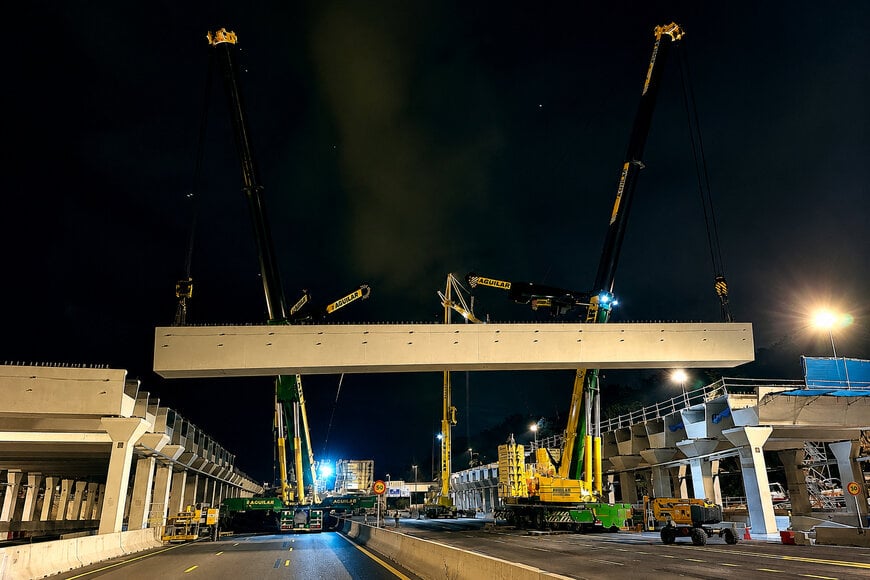
Grúas Aguilar deployed a fleet of specialized Liebherr cranes to construct a massive urban overpass in Madrid.
www.liebherr.com
Application area: Infrastructure engineering and urban development
Industry sector: Heavy lifting and construction logistics
The infrastructure development requires constructing a 16,000-square-metre pedestrian and green zone that extends nearly 200 metres across the active M-30 motorway in Madrid. The primary operational hurdle was a strict requirement to execute all heavy lifting exclusively at night between 10 pm and 6 am. This compressed timeframe left no margin for error, requiring rapid machinery deployment, precise placement, and high mechanical reliability to guarantee that the motorway could safely reopen to public traffic each morning.
Logistical goals for high-tonnage structural positioning
The contractor needed to transport, assemble, and operate multiple high-capacity machines capable of handling extreme structural loads within an eight-hour nightly window. The primary goals were centered on structural safety and minimizing traffic disruption. The tasks involved lifting concrete main structure girders weighing up to 184 tonnes, intermediate components between 120 and 130 tonnes, 25-tonne vertical pillars, and expansive horizontal floor slabs.
Strategic fleet deployment for heavy structural lifts
To meet these demanding engineering criteria, Spanish crane specialist Grúas Aguilar deployed a fleet of seven Liebherr machines, consisting of six mobile telescopic cranes with capacities from 95 to 800 tonnes and one mobile construction crane.
The machinery configuration was allocated based on specific load and reach requirements:
- Two heavy-duty models, an LTM 1650-8.1 and an LTM 1750-9.1, hoisted the main 184-tonne concrete girders using telescopic booms extended to 40 metres at a working radius of up to 20 metres.
- An LTM 1500-8.1 and a second LTM 1650-8.1 crane worked to install the 120-tonne girders, while an additional LTM 1750-9.1 handled the 130-tonne components.
- An LTM 1095-5.1 mobile crane was selected for its mobility and precision to erect the 25-tonne vertical pillars.
- An MK 140-5.1 mobile construction crane was utilized to handle the precise positioning and laying of the floor slabs.
Pre-project planning and technical support logistics
Grúas Aguilar selected this specific equipment combination due to the high load charts, boom reach capabilities, and proven reliability of the machinery. Because more than 90 percent of the company's 200-crane fleet consists of machines from this manufacturer, the operators were highly familiar with the systems. The deployment process was further supported by the manufacturer's local service team, Liebherr Ibérica, which collaborated during the early planning stages to develop detailed lifting concepts and technical engineering safety plans.
Scheduled execution results within tight operational windows
Through coordinated crane capacities and detailed engineering layouts, the technical teams successfully placed the critical structural components within the tight nightly deadlines. The combined configuration allowed for the safe positioning of the 184-tonne main girders and subsequent support elements without causing daytime traffic delays. This systematic execution ensures the infrastructure project remains on track to establish the new connection between the Salamanca and Ciudad Lineal districts by spring 2027.
Edited by Sucithra Mani, Induportals editor – adapted by AI.
www.liebherr.com
Powered by
Induportals Media Publishing