Liebherr unplugged crane electrifies Dutch hydraulic construction project
De Klerk Werkendam utilizes the battery-powered LR 1130.1 to install sheet piles with zero local emissions. www.liebherr.com De Klerk Werkendam is utilizing Liebherr’s battery-powered LR 1130.1 unplugged crawler crane to refurbish the Brouwer sluice lock complex on the Brouwersdam in the Netherlands. Tasked with replacing 50-year-old sheet pile structures that regulate water flow between the North Sea and the Grevelingenmeer, the contractor is demonstrating the viability of heavy-duty, zero-emission lifting equipment in demanding hydraulic engineering environments. High-capacity lifting from a floating pontoon The project requires the installation of 162 new 23-meter-long sheet piles into highly compacted sandy soil. Operating directly from a work barge, the LR 1130.1 unplugged leverages its extensive working radius to precisely position the heavy steel piles and load building materials from the shore. The highly densified embankment demands a high-performance vibratory hammer, requiring a crawler crane with robust structural stability and lifting capacity to safely manage the severe dynamic loads generated during the pile-driving and extraction processes. As soon as the new elements are installed, the old piles are removed to lay the foundations for the modern lock system. Seamless transition to zero-emission operations To meet increasingly stringent jobsite emission regulations, De Klerk Werkendam deployed the LR 1130.1 unplugged alongside a specialized hybrid work pontoon. The crane's onboard battery system can be charged via a conventional site power supply, allowing operations to continue seamlessly while plugged in, or fully untethered with lifting performance identical to its diesel-powered counterpart. Combined with the pontoon's electric drive, electric spud poles, and solar-battery hybrid system, the setup operates almost entirely free of local emissions. Furthermore, the electric drive drastically reduces noise pollution; at idle, the sound pressure level of three unplugged cranes equals that of a normal conversation, vastly improving communication and safety for the site crew. Additional Context: Dynamic loads and electric torque in vibratory sheet piling This section details technical specifications and operational mechanics not included in the original project report. In hydraulic engineering, driving 23-meter sheet piles using a vibratory hammer subjects the base machine to severe dynamic stresses. The high-frequency vibrations from the hammer travel directly up the hoist rope and into the crane's boom, requiring highly specialized structural fatigue engineering and heavy-duty free-fall winch systems to prevent mechanical failure. Furthermore, when extracting 50-year-old piles from compacted, water-logged soil, the crane must overcome massive static friction and suction forces. In these scenarios, battery-electric crawler cranes like the LR 1130.1 unplugged offer a distinct mechanical advantage: unlike internal combustion engines that must build up RPMs to reach peak power, electric motors deliver maximum torque instantaneously from zero RPM. This provides the operator with a smooth, highly responsive, and infinitely controllable lifting force, eliminating the lag or stalling risks associated with traditional diesel engine torque curves during heavy extraction operations. Edited by an industrial journalist, Lekshman Ramdas, with AI assistance. www.liebherr.com Powered by Induportals Media Publishing
 machineryasia

De Klerk Werkendam utilizes the battery-powered LR 1130.1 to install sheet piles with zero local emissions.
www.liebherr.com
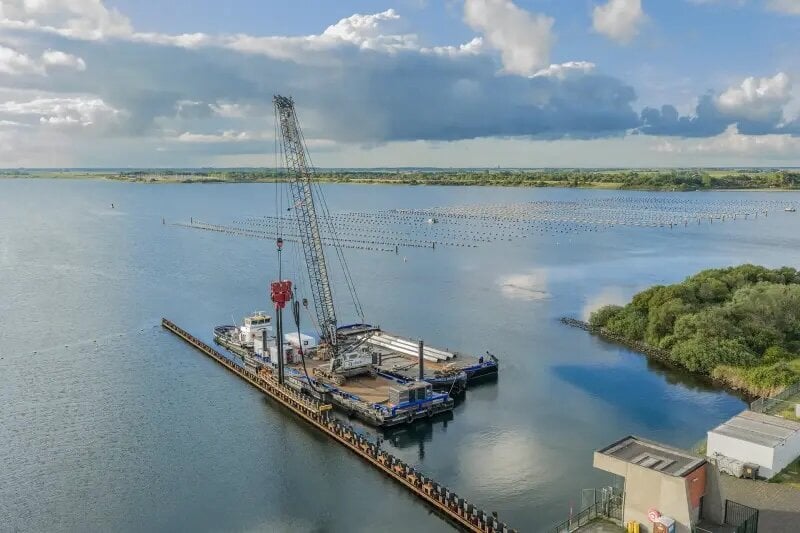
De Klerk Werkendam is utilizing Liebherr’s battery-powered LR 1130.1 unplugged crawler crane to refurbish the Brouwer sluice lock complex on the Brouwersdam in the Netherlands. Tasked with replacing 50-year-old sheet pile structures that regulate water flow between the North Sea and the Grevelingenmeer, the contractor is demonstrating the viability of heavy-duty, zero-emission lifting equipment in demanding hydraulic engineering environments.
High-capacity lifting from a floating pontoon
The project requires the installation of 162 new 23-meter-long sheet piles into highly compacted sandy soil. Operating directly from a work barge, the LR 1130.1 unplugged leverages its extensive working radius to precisely position the heavy steel piles and load building materials from the shore. The highly densified embankment demands a high-performance vibratory hammer, requiring a crawler crane with robust structural stability and lifting capacity to safely manage the severe dynamic loads generated during the pile-driving and extraction processes. As soon as the new elements are installed, the old piles are removed to lay the foundations for the modern lock system.
Seamless transition to zero-emission operations
To meet increasingly stringent jobsite emission regulations, De Klerk Werkendam deployed the LR 1130.1 unplugged alongside a specialized hybrid work pontoon. The crane's onboard battery system can be charged via a conventional site power supply, allowing operations to continue seamlessly while plugged in, or fully untethered with lifting performance identical to its diesel-powered counterpart. Combined with the pontoon's electric drive, electric spud poles, and solar-battery hybrid system, the setup operates almost entirely free of local emissions. Furthermore, the electric drive drastically reduces noise pollution; at idle, the sound pressure level of three unplugged cranes equals that of a normal conversation, vastly improving communication and safety for the site crew.
Additional Context: Dynamic loads and electric torque in vibratory sheet piling
This section details technical specifications and operational mechanics not included in the original project report.
In hydraulic engineering, driving 23-meter sheet piles using a vibratory hammer subjects the base machine to severe dynamic stresses. The high-frequency vibrations from the hammer travel directly up the hoist rope and into the crane's boom, requiring highly specialized structural fatigue engineering and heavy-duty free-fall winch systems to prevent mechanical failure. Furthermore, when extracting 50-year-old piles from compacted, water-logged soil, the crane must overcome massive static friction and suction forces. In these scenarios, battery-electric crawler cranes like the LR 1130.1 unplugged offer a distinct mechanical advantage: unlike internal combustion engines that must build up RPMs to reach peak power, electric motors deliver maximum torque instantaneously from zero RPM. This provides the operator with a smooth, highly responsive, and infinitely controllable lifting force, eliminating the lag or stalling risks associated with traditional diesel engine torque curves during heavy extraction operations.
Edited by an industrial journalist, Lekshman Ramdas, with AI assistance.
www.liebherr.com
Powered by
Induportals Media Publishing