Liebherr LTM 1400-6.1 Demonstrates Rapid Crane Assembly
New mobile crane integrates automated coupling and modular Superlift system to reduce setup time and improve lifting efficiency in constrained urban environments. www.liebherr.com Urban construction projects increasingly require high-capacity lifting equipment that can be deployed quickly within limited space, particularly in dense cities such as Paris. In this context, Liebherr’s LTM 1400-6.1 mobile crane was deployed by Montagrues for the dismantling of a high-rise tower crane, demonstrating its setup efficiency and lifting capability. First deployment under constrained site conditions The crane was used to dismantle a construction crane with a hook height of approximately 75 metres in a restricted urban footprint. The operation required rapid setup and precise positioning, reflecting typical constraints in metropolitan construction environments. The LTM 1400-6.1, a 400-tonne class mobile crane, was positioned on site before dawn, with setup operations conducted under tight time constraints. The process included ballast installation, boom preparation, and integration of the Y-guying system, also referred to as Superlift. Accelerating setup with automated coupling systems A key feature of the deployment was the self-assembly of the Y-guying system. The crane lifts the complete system from a transport vehicle and positions it onto its undercarriage. During boom luffing, a hydraulic quick coupling automatically connects the Y-guying system to the telescopic boom. The coupling and bolting process is hydraulically controlled, requiring manual intervention only for the electrical connection. This reduces manual assembly steps and enables faster system integration compared to conventional setups. The process is supported by the Solidlink quick coupling system, adapted from earthmoving equipment. Solidlink enables automated mechanical and hydraulic connections, reducing setup time and minimizing operator intervention during assembly. Reducing setup time for high-capacity lifting Following positioning, approximately 90 tonnes of ballast were installed, and the Y-guying system was assembled and made operational within roughly two hours. The Superlift system itself was installed in less than one hour during its first deployment. Such setup times are relevant in construction scenarios where crane availability and operational windows are limited. Faster assembly allows contractors to begin lifting operations sooner, improving project scheduling efficiency. Supporting heavy lifting in limited footprints The LTM 1400-6.1 was configured with a 17.5-metre fixed jib to dismantle the tower crane. Despite the restricted site conditions, the crane maintained lifting performance, enabling safe handling of large structural components. This type of deployment is common in urban construction and infrastructure projects, where space constraints limit crane positioning and require compact yet high-capacity lifting solutions. Fleet integration and operational continuity The deployment also reflects broader equipment strategies among crane operators. Both Montagrues and STME Grues operate fleets composed entirely of Liebherr mobile cranes, covering a range of lifting capacities from 30 tonnes to higher-capacity models. Such fleet standardization supports operational consistency, maintenance efficiency, and compatibility across projects. It also allows operators to select equipment based on lifting requirements while maintaining familiarity with control systems and setup procedures. The LTM 1400-6.1 deployment in Paris illustrates how automated coupling systems, modular lifting components, and compact crane design contribute to faster setup and efficient operation in constrained environments. These capabilities are increasingly relevant as construction projects demand shorter timelines and higher operational precision. Edited by Aishwarya Mambet, Induportals Editor, with AI assistance. www.liebherr.com Powered by Induportals Media Publishing
 machineryasia
New mobile crane integrates automated coupling and modular Superlift system to reduce setup time and improve lifting efficiency in constrained urban environments.
www.liebherr.com
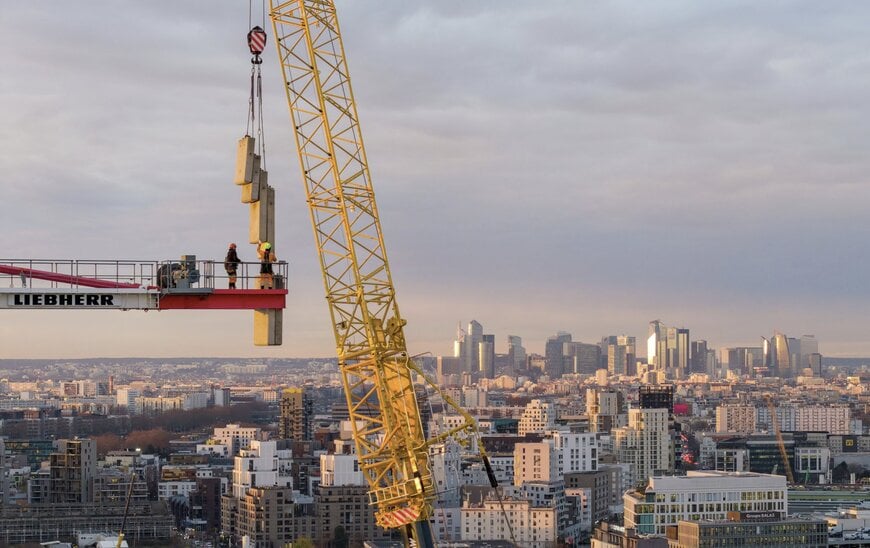
Urban construction projects increasingly require high-capacity lifting equipment that can be deployed quickly within limited space, particularly in dense cities such as Paris. In this context, Liebherr’s LTM 1400-6.1 mobile crane was deployed by Montagrues for the dismantling of a high-rise tower crane, demonstrating its setup efficiency and lifting capability.
First deployment under constrained site conditions
The crane was used to dismantle a construction crane with a hook height of approximately 75 metres in a restricted urban footprint. The operation required rapid setup and precise positioning, reflecting typical constraints in metropolitan construction environments.
The LTM 1400-6.1, a 400-tonne class mobile crane, was positioned on site before dawn, with setup operations conducted under tight time constraints. The process included ballast installation, boom preparation, and integration of the Y-guying system, also referred to as Superlift.
Accelerating setup with automated coupling systems
A key feature of the deployment was the self-assembly of the Y-guying system. The crane lifts the complete system from a transport vehicle and positions it onto its undercarriage. During boom luffing, a hydraulic quick coupling automatically connects the Y-guying system to the telescopic boom.
The coupling and bolting process is hydraulically controlled, requiring manual intervention only for the electrical connection. This reduces manual assembly steps and enables faster system integration compared to conventional setups.
The process is supported by the Solidlink quick coupling system, adapted from earthmoving equipment. Solidlink enables automated mechanical and hydraulic connections, reducing setup time and minimizing operator intervention during assembly.
Reducing setup time for high-capacity lifting
Following positioning, approximately 90 tonnes of ballast were installed, and the Y-guying system was assembled and made operational within roughly two hours. The Superlift system itself was installed in less than one hour during its first deployment.
Such setup times are relevant in construction scenarios where crane availability and operational windows are limited. Faster assembly allows contractors to begin lifting operations sooner, improving project scheduling efficiency.
Supporting heavy lifting in limited footprints
The LTM 1400-6.1 was configured with a 17.5-metre fixed jib to dismantle the tower crane. Despite the restricted site conditions, the crane maintained lifting performance, enabling safe handling of large structural components.
This type of deployment is common in urban construction and infrastructure projects, where space constraints limit crane positioning and require compact yet high-capacity lifting solutions.
Fleet integration and operational continuity
The deployment also reflects broader equipment strategies among crane operators. Both Montagrues and STME Grues operate fleets composed entirely of Liebherr mobile cranes, covering a range of lifting capacities from 30 tonnes to higher-capacity models.
Such fleet standardization supports operational consistency, maintenance efficiency, and compatibility across projects. It also allows operators to select equipment based on lifting requirements while maintaining familiarity with control systems and setup procedures.
The LTM 1400-6.1 deployment in Paris illustrates how automated coupling systems, modular lifting components, and compact crane design contribute to faster setup and efficient operation in constrained environments. These capabilities are increasingly relevant as construction projects demand shorter timelines and higher operational precision.
Edited by Aishwarya Mambet, Induportals Editor, with AI assistance.
www.liebherr.com
Powered by
Induportals Media Publishing