High-Performance Cable Carriers for Extended Travel Lengths
TSUBAKI KABELSCHLEPP introduces the TKHP series to provide durable cable routing solutions for heavy-duty industrial applications and large-scale bulk material handling systems. www.tsubaki.com The TKHP series is engineered to facilitate reliable cable management in demanding environments characterized by heavy debris and long travel distances. Specifically developed for port cranes and bulk material transport, this series supports travel lengths of up to 1,500 meters. By utilizing a high-performance (HP) design, the system maintains structural integrity under significant mechanical loads, making it a critical component within the modern digital supply chain where uptime and automated logistics are paramount. Structural Engineering and Force Transmission The technical efficiency of the TKHP series stems from a symmetrical longitudinal axis design. This geometry optimizes force transmission throughout the carrier system and minimizes the torques generated at the turning point of the chain. To ensure longevity in abrasive conditions, the series features an encapsulated stroke system and a reinforced pin-hole connection. The outer contour is designed to be self-cleaning and dirt-resistant, preventing the accumulation of particulates that typically lead to mechanical failure. Sturdiness is further reinforced by solid sidebands and bolted chain links utilizing a double-fork and tab construction. These elements allow the carrier to withstand the high tensile forces associated with moving heavy cable loads over hundreds of meters. Performance Variants and Roller Damping Mechanisms Available in two primary specifications — TKHP 85 and TKHP 90 — the series offers inner heights of 58 mm and 92 mm, respectively. Widths are customizable in 1-mm increments to integrate into specific automotive data ecosystem infrastructures or heavy industrial frameworks. The series is divided into three functional variants: gliding, rolling (R), and rolling with roller damping (RSD). The RSD variant incorporates a polygon-optimized outer contour and an integrated brake system to ensure smooth operation. A primary technical advancement is the roller damping system, which functions without additional mechanical components such as springs or bolts. This mechanism reduces the mechanical load experienced when the carrier transitions over rollers by 50%. This reduction in impact force directly correlates to lower noise emissions and a significant decrease in component wear. Material Durability and Environmental Resistance To protect the internal cables, the TKHP series utilizes aluminum opening stays that are resistant to seawater, making the system suitable for coastal maritime applications. The running faces are designed with "grip grooves" to maintain roller traction in environments saturated with fine dust, such as cement or coal plants. By ensuring constant roller rotation, these grooves prevent the flat spots and one-sided wear typically caused by blocked rollers in high-dust environments. The system’s small pitches of 85 mm or 90 mm contribute to a reduction in the polygon effect, resulting in quieter operation and a more stable platform for sensitive data and power cables. These design choices ensure the cable carrier functions as a low-maintenance link in high-performance industrial automation. Edited by Evgeny Churilov, Induportals Media - Adapted by AI. www.tsubaki.com Powered by Induportals Media Publishing
 machineryasia
TSUBAKI KABELSCHLEPP introduces the TKHP series to provide durable cable routing solutions for heavy-duty industrial applications and large-scale bulk material handling systems.
www.tsubaki.com
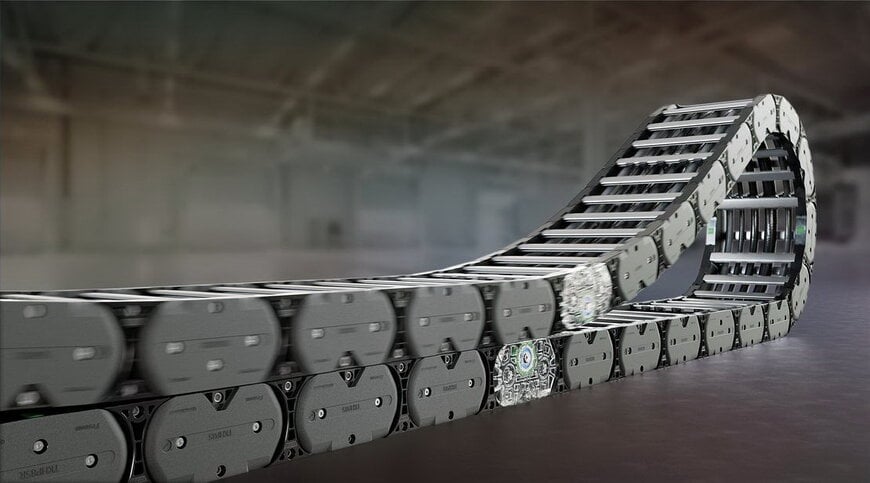
The TKHP series is engineered to facilitate reliable cable management in demanding environments characterized by heavy debris and long travel distances. Specifically developed for port cranes and bulk material transport, this series supports travel lengths of up to 1,500 meters. By utilizing a high-performance (HP) design, the system maintains structural integrity under significant mechanical loads, making it a critical component within the modern digital supply chain where uptime and automated logistics are paramount.
Structural Engineering and Force Transmission
The technical efficiency of the TKHP series stems from a symmetrical longitudinal axis design. This geometry optimizes force transmission throughout the carrier system and minimizes the torques generated at the turning point of the chain. To ensure longevity in abrasive conditions, the series features an encapsulated stroke system and a reinforced pin-hole connection.
The outer contour is designed to be self-cleaning and dirt-resistant, preventing the accumulation of particulates that typically lead to mechanical failure. Sturdiness is further reinforced by solid sidebands and bolted chain links utilizing a double-fork and tab construction. These elements allow the carrier to withstand the high tensile forces associated with moving heavy cable loads over hundreds of meters.
Performance Variants and Roller Damping Mechanisms
Available in two primary specifications — TKHP 85 and TKHP 90 — the series offers inner heights of 58 mm and 92 mm, respectively. Widths are customizable in 1-mm increments to integrate into specific automotive data ecosystem infrastructures or heavy industrial frameworks. The series is divided into three functional variants: gliding, rolling (R), and rolling with roller damping (RSD).
The RSD variant incorporates a polygon-optimized outer contour and an integrated brake system to ensure smooth operation. A primary technical advancement is the roller damping system, which functions without additional mechanical components such as springs or bolts. This mechanism reduces the mechanical load experienced when the carrier transitions over rollers by 50%. This reduction in impact force directly correlates to lower noise emissions and a significant decrease in component wear.
Material Durability and Environmental Resistance
To protect the internal cables, the TKHP series utilizes aluminum opening stays that are resistant to seawater, making the system suitable for coastal maritime applications. The running faces are designed with "grip grooves" to maintain roller traction in environments saturated with fine dust, such as cement or coal plants. By ensuring constant roller rotation, these grooves prevent the flat spots and one-sided wear typically caused by blocked rollers in high-dust environments.
The system’s small pitches of 85 mm or 90 mm contribute to a reduction in the polygon effect, resulting in quieter operation and a more stable platform for sensitive data and power cables. These design choices ensure the cable carrier functions as a low-maintenance link in high-performance industrial automation.
Edited by Evgeny Churilov, Induportals Media - Adapted by AI.
www.tsubaki.com
Powered by
Induportals Media Publishing