Hiap Heng Acquires First Liebherr Mobile Construction Crane
The MK 88-4.1E electric crane enables the Singapore-based contractor to tackle space-constrained urban construction projects efficiently. www.liebherr.com Liebherr mobile construction cranes are characterised by their flexibility as ‘taxi cranes’, particularly for use in densely built-up city centres, such as those commonly found in Singapore. The crane can be erected quickly and can be set up by a single person. Singapore-based Hiap Heng Group has acquired its first Liebherr mobile construction crane, the MK 88-4.1E, marking the company's strategic entry into this specific equipment market. Operating a fleet of over 100 large-scale machines, the contractor invested in the versatile crane to address the complex logistical challenges of working in densely built-up urban environments. The new asset will be deployed across a variety of infrastructure and commercial projects, including office buildings, hospitals, and shopping centers, where severe space constraints often restrict the use of conventional lifting equipment. The MK 88-4.1E functions as a highly maneuverable taxi crane, designed so that transport, erection, and operation can be entirely managed by a single operator. Its vertical tower and asymmetrical outrigger configuration allow it to be positioned directly against structures, offering wide working radii while maintaining a minimal ground footprint. Furthermore, the crane features a powerful electric drive capable of running on site power or an integrated generator. This electric operation drastically reduces on-site noise and exhaust emissions, aligning with Singapore’s increasing demand for sustainable construction methods while enabling rapid setup times for multiple daily deployments. Additional Context This section provides technological and market background not explicitly detailed in the original release. In highly urbanized city-states like Singapore, construction sites are frequently characterized by zero-lot-line developments, heavy pedestrian traffic, and strict municipal regulations regarding noise and diesel emissions. Traditional tower cranes require extensive setup time, concrete foundations, and multi-day assembly, while conventional mobile telescopic cranes often lack the necessary reach to clear tall obstacles without a massive ground footprint. The mobile folding construction crane bridges this gap by combining the rapid road mobility of a mobile crane with the vertical mast and horizontal jib advantages of a tower crane. Running the crane electrically via a 32-amp shore power connection eliminates diesel engine idling during extended lifting operations, significantly lowering the overall carbon footprint of the job site and allowing for extended working hours in noise-sensitive residential or hospital zones. Edited by Lekshman Ramdas, Induportals editor – adapted by AI. www.liebherr.com Powered by Induportals Media Publishing
 machineryasia
The MK 88-4.1E electric crane enables the Singapore-based contractor to tackle space-constrained urban construction projects efficiently.
www.liebherr.com
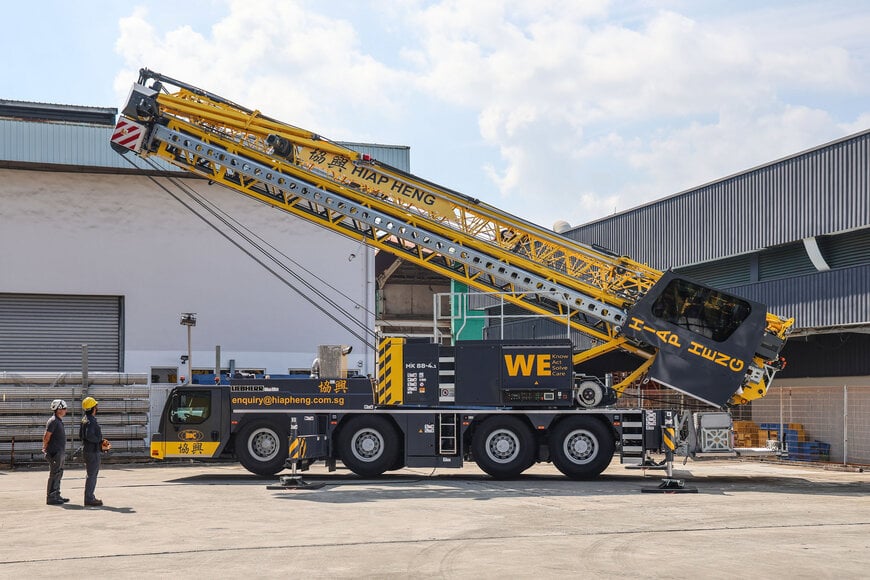
Liebherr mobile construction cranes are characterised by their flexibility as ‘taxi cranes’, particularly for use in densely built-up city centres, such as those commonly found in Singapore. The crane can be erected quickly and can be set up by a single person.
Singapore-based Hiap Heng Group has acquired its first Liebherr mobile construction crane, the MK 88-4.1E, marking the company's strategic entry into this specific equipment market. Operating a fleet of over 100 large-scale machines, the contractor invested in the versatile crane to address the complex logistical challenges of working in densely built-up urban environments. The new asset will be deployed across a variety of infrastructure and commercial projects, including office buildings, hospitals, and shopping centers, where severe space constraints often restrict the use of conventional lifting equipment.
The MK 88-4.1E functions as a highly maneuverable taxi crane, designed so that transport, erection, and operation can be entirely managed by a single operator. Its vertical tower and asymmetrical outrigger configuration allow it to be positioned directly against structures, offering wide working radii while maintaining a minimal ground footprint. Furthermore, the crane features a powerful electric drive capable of running on site power or an integrated generator. This electric operation drastically reduces on-site noise and exhaust emissions, aligning with Singapore’s increasing demand for sustainable construction methods while enabling rapid setup times for multiple daily deployments.
Additional Context
This section provides technological and market background not explicitly detailed in the original release.
In highly urbanized city-states like Singapore, construction sites are frequently characterized by zero-lot-line developments, heavy pedestrian traffic, and strict municipal regulations regarding noise and diesel emissions. Traditional tower cranes require extensive setup time, concrete foundations, and multi-day assembly, while conventional mobile telescopic cranes often lack the necessary reach to clear tall obstacles without a massive ground footprint. The mobile folding construction crane bridges this gap by combining the rapid road mobility of a mobile crane with the vertical mast and horizontal jib advantages of a tower crane. Running the crane electrically via a 32-amp shore power connection eliminates diesel engine idling during extended lifting operations, significantly lowering the overall carbon footprint of the job site and allowing for extended working hours in noise-sensitive residential or hospital zones.
Edited by Lekshman Ramdas, Induportals editor – adapted by AI.
www.liebherr.com
Singapore-based Hiap Heng Group has acquired its first Liebherr mobile construction crane, the MK 88-4.1E, marking the company's strategic entry into this specific equipment market. Operating a fleet of over 100 large-scale machines, the contractor invested in the versatile crane to address the complex logistical challenges of working in densely built-up urban environments. The new asset will be deployed across a variety of infrastructure and commercial projects, including office buildings, hospitals, and shopping centers, where severe space constraints often restrict the use of conventional lifting equipment.
The MK 88-4.1E functions as a highly maneuverable taxi crane, designed so that transport, erection, and operation can be entirely managed by a single operator. Its vertical tower and asymmetrical outrigger configuration allow it to be positioned directly against structures, offering wide working radii while maintaining a minimal ground footprint. Furthermore, the crane features a powerful electric drive capable of running on site power or an integrated generator. This electric operation drastically reduces on-site noise and exhaust emissions, aligning with Singapore’s increasing demand for sustainable construction methods while enabling rapid setup times for multiple daily deployments.
Additional Context
This section provides technological and market background not explicitly detailed in the original release.
In highly urbanized city-states like Singapore, construction sites are frequently characterized by zero-lot-line developments, heavy pedestrian traffic, and strict municipal regulations regarding noise and diesel emissions. Traditional tower cranes require extensive setup time, concrete foundations, and multi-day assembly, while conventional mobile telescopic cranes often lack the necessary reach to clear tall obstacles without a massive ground footprint. The mobile folding construction crane bridges this gap by combining the rapid road mobility of a mobile crane with the vertical mast and horizontal jib advantages of a tower crane. Running the crane electrically via a 32-amp shore power connection eliminates diesel engine idling during extended lifting operations, significantly lowering the overall carbon footprint of the job site and allowing for extended working hours in noise-sensitive residential or hospital zones.
Edited by Lekshman Ramdas, Induportals editor – adapted by AI.
www.liebherr.com
Powered by
Induportals Media Publishing