Fleet Expansion: Salgert Integrates LTM 1400-6.1 Mobile Crane
The Salgert Group enhances its heavy-lift capabilities with Liebherr’s 450-tonne mobile crane, prioritizing operational flexibility and performance. www.liebherr.com Industry Sector: Heavy-lift engineering and mobile crane services. Application Area: Industrial infrastructure, energy, and heavy-load installation projects. The Salgert Group has expanded its all-Liebherr crane fleet with the addition of an LTM 1400-6.1. This 450-tonne mobile crane is designed to handle increasingly complex projects in infrastructure, energy, and industrial sectors. The investment reflects a strategic upgrade in heavy-lift technology, enabling the company to tackle heavier and more demanding load requirements while maintaining cost-effective operational procedures. Technical Capabilities and Versatility The LTM 1400-6.1 is engineered for rapid deployment and high lifting capacity, featuring several key technical advantages for varied jobsite requirements: Boom System: Equipped with a 70-metre telescopic boom and a modular boom system designed for straightforward, efficient setup. Y-Guying System: Integrated support for the telescopic boom significantly enhances load-bearing capacity; the LTM 1400-6.1 represents the smallest Liebherr model to utilize this high-performance technology. Operational Flexibility: The crane offers a 135-degree swivelling capacity (in relation to the carrier) and is configured to transition quickly between different lifting tasks, optimizing downtime on-site. Strategic Fleet Management With a fleet consisting entirely of Liebherr equipment across four German locations, the Salgert Group prioritizes standardization to maximize maintenance efficiency and spare parts availability. This fleet expansion follows a long-standing partnership strategy, allowing the company to consolidate its expertise in heavy-lift technology while meeting the evolving scale and complexity of client requirements in the energy and industrial infrastructure markets. Additional Context: Engineering considerations for 450-tonne class cranes The LTM 1400-6.1 occupies a critical "gap" in the mobile crane market, providing the power of a large-class machine with the mobility of a 6-axle carrier. The engineering challenge in this class is maintaining road-legal axle loads while providing the structural rigidity required for high-capacity lifts. The use of a "Y-guying" system (a tension-based support structure for the boom) is essential because it counteracts the deflection (bending) of the long telescopic boom under heavy loads, effectively allowing the crane to perform lifts that would otherwise require a larger, heavier machine. Furthermore, Liebherr’s control software plays a pivotal role in safety; the system calculates the "load chart" dynamically, meaning it assesses the crane’s stability based on real-time data from outrigger force sensors and boom inclination. This is critical in urban environments or confined industrial settings where the crane’s supporting base cannot be fully extended. Edited by Lekshman Ramdas, Induportals editor – adapted by AI. www.liebherr.com Powered by Induportals Media Publishing
 machineryasia
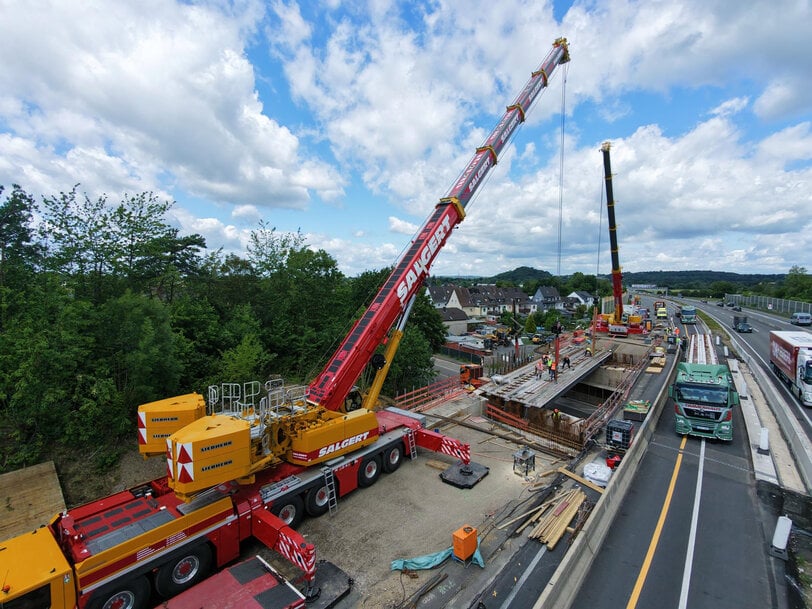
The Salgert Group enhances its heavy-lift capabilities with Liebherr’s 450-tonne mobile crane, prioritizing operational flexibility and performance.
www.liebherr.com
Industry Sector: Heavy-lift engineering and mobile crane services.
Application Area: Industrial infrastructure, energy, and heavy-load installation projects.
The Salgert Group has expanded its all-Liebherr crane fleet with the addition of an LTM 1400-6.1. This 450-tonne mobile crane is designed to handle increasingly complex projects in infrastructure, energy, and industrial sectors. The investment reflects a strategic upgrade in heavy-lift technology, enabling the company to tackle heavier and more demanding load requirements while maintaining cost-effective operational procedures.
Technical Capabilities and Versatility
The LTM 1400-6.1 is engineered for rapid deployment and high lifting capacity, featuring several key technical advantages for varied jobsite requirements:
- Boom System: Equipped with a 70-metre telescopic boom and a modular boom system designed for straightforward, efficient setup.
- Y-Guying System: Integrated support for the telescopic boom significantly enhances load-bearing capacity; the LTM 1400-6.1 represents the smallest Liebherr model to utilize this high-performance technology.
- Operational Flexibility: The crane offers a 135-degree swivelling capacity (in relation to the carrier) and is configured to transition quickly between different lifting tasks, optimizing downtime on-site.
Strategic Fleet Management
With a fleet consisting entirely of Liebherr equipment across four German locations, the Salgert Group prioritizes standardization to maximize maintenance efficiency and spare parts availability. This fleet expansion follows a long-standing partnership strategy, allowing the company to consolidate its expertise in heavy-lift technology while meeting the evolving scale and complexity of client requirements in the energy and industrial infrastructure markets.
Additional Context: Engineering considerations for 450-tonne class cranes
The LTM 1400-6.1 occupies a critical "gap" in the mobile crane market, providing the power of a large-class machine with the mobility of a 6-axle carrier. The engineering challenge in this class is maintaining road-legal axle loads while providing the structural rigidity required for high-capacity lifts. The use of a "Y-guying" system (a tension-based support structure for the boom) is essential because it counteracts the deflection (bending) of the long telescopic boom under heavy loads, effectively allowing the crane to perform lifts that would otherwise require a larger, heavier machine. Furthermore, Liebherr’s control software plays a pivotal role in safety; the system calculates the "load chart" dynamically, meaning it assesses the crane’s stability based on real-time data from outrigger force sensors and boom inclination. This is critical in urban environments or confined industrial settings where the crane’s supporting base cannot be fully extended.
Edited by Lekshman Ramdas, Induportals editor – adapted by AI.
www.liebherr.com
With a fleet consisting entirely of Liebherr equipment across four German locations, the Salgert Group prioritizes standardization to maximize maintenance efficiency and spare parts availability. This fleet expansion follows a long-standing partnership strategy, allowing the company to consolidate its expertise in heavy-lift technology while meeting the evolving scale and complexity of client requirements in the energy and industrial infrastructure markets.
Additional Context: Engineering considerations for 450-tonne class cranes
The LTM 1400-6.1 occupies a critical "gap" in the mobile crane market, providing the power of a large-class machine with the mobility of a 6-axle carrier. The engineering challenge in this class is maintaining road-legal axle loads while providing the structural rigidity required for high-capacity lifts. The use of a "Y-guying" system (a tension-based support structure for the boom) is essential because it counteracts the deflection (bending) of the long telescopic boom under heavy loads, effectively allowing the crane to perform lifts that would otherwise require a larger, heavier machine. Furthermore, Liebherr’s control software plays a pivotal role in safety; the system calculates the "load chart" dynamically, meaning it assesses the crane’s stability based on real-time data from outrigger force sensors and boom inclination. This is critical in urban environments or confined industrial settings where the crane’s supporting base cannot be fully extended.
Edited by Lekshman Ramdas, Induportals editor – adapted by AI.
www.liebherr.com
Powered by
Induportals Media Publishing