Factory Jobs, Charted
A clear-eyed look at U.S. manufacturing employment shows a sector not too hot, and also not nearly as cold as the critics suggest.
 machineryasia
A clear-eyed look at U.S. manufacturing employment shows a sector not too hot, and also not nearly as cold as the critics suggest.
A recent story in the Washington Post is the latest entry in the ongoing debate over how factories are faring amid tariffs, energy costs, consumer sentiment and other pressures. It is easy to choose a side on this question and, more often than not, political preference plays the primary role.
So let’s cut through the rhetoric and hot takes to examine how factory jobs are really doing. Here is the short answer: Manufacturing is not in dire straits, as some might suggest, but it is not booming from a jobs perspective either. At least not yet.
First, let’s look at this year so far.
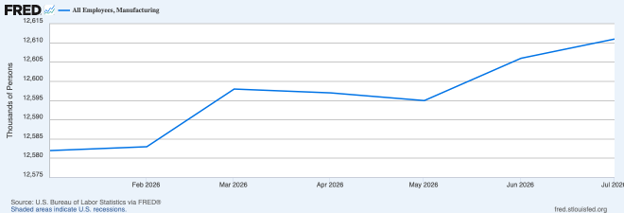
This snapshot is encouraging. Factories have added 31,000 jobs this year, showing modest upward movement. Can we call this a trend? It is probably too early to tell, but other indicators, such as the Institute for Supply Management gauge for manufacturing, are encouraging.
Now let’s examine how factory employment looks during President Trump’s second term.
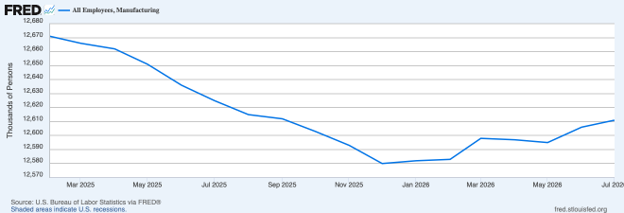
By this measure, factory employment has fallen by roughly 62,000 jobs since Inauguration Day 2025. Many Democratic critics and tariff critics have focused on this time horizon. On one hand, that frame is useful because Trump has repeatedly claimed he is ushering in a factory renaissance. On the other hand, it is somewhat arbitrary, as the next chart shows.
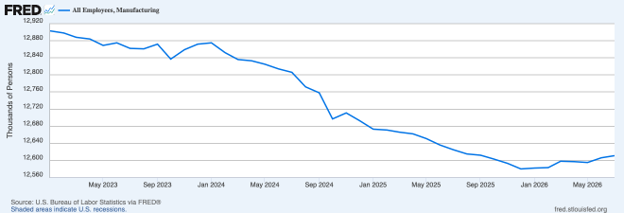
The chart above shows the factory job trend since the most recent peak in manufacturing employment in January 2023. From that point through January 2025, manufacturing employment fell by 321,000 jobs, and most of that decline – about 230,000 jobs – occurred during the Biden administration. Higher interest rates, elevated costs from supply chain shocks and a weak global economy all contributed to the downturn. It is exceptionally unfair to pin that decline on new tariffs that began taking effect in the first quarter of 2025.
Two final points are worth emphasizing in this chartbook. The first is encouraging:
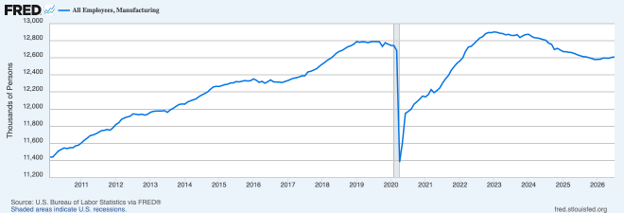
This chart shows the factory job trend since the bottom of the Great Recession employment crash. Since then, the United States has added 1.17 million factory jobs. What does that represent? Resilience. Despite the pandemic shock. Despite China’s persistent cheating. Through very different presidents: Obama, Trump, Biden, and Trump again. In the face of automation and robotics. That tells me there is a future in this industry, particularly if policymakers invest in America and confront persistent cheating abroad.
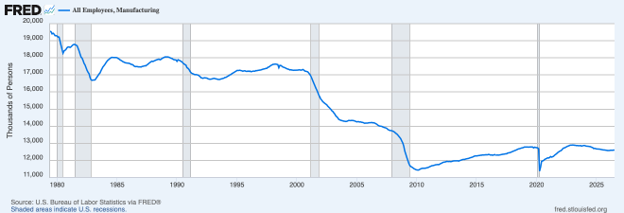
But here is the reality check. American factory employment will never return to its all-time peak in 1979. Put simply, there was far less competition, less automation and stronger union density that made outsourcing more difficult.
Nostalgia, however, is not the point of industrial policy and tariffs. The point is it can help chart our future: good jobs, a strong middle class and security for our nation. Over the past 15 years there is evidence that hitting rock bottom helped wake up both political parties. There will always be a competition of ideas over how best to support manufacturing, and we welcome that debate. But dismissing these efforts for purely partisan reasons, as we have seen at times over the past decade, is a big mistake.