Emission-Free Construction and Precision Control in Compact Machinery
Wacker Neuson introduces redesigned mini-excavators, remote-controlled trench rollers, and battery-powered trowels to enhance operational safety and efficiency in the automotive data ecosystem. www.wackerneuson.co.uk The transition toward electrified and precision-controlled construction equipment is driven by the requirement for localized zero-emission operation and improved mechanical accuracy. Wacker Neuson has expanded its portfolio with a redesigned generation of 2-ton class mini-excavators, an infrared-monitored trench roller, and battery-powered trowels designed for indoor concrete finishing. These technologies address specific technical challenges in urban infrastructure and industrial flooring where space constraints and air quality standards are primary operational variables. Hydraulic Precision and Variable Undercarriage Geometry The ET18, ET20, and ET25 mini-excavators utilize a redesigned hydraulic architecture to manage complex task sequences. A primary technical feature in this class is the integration of parallel auxiliary control circuits. These circuits allow operators to toggle functions via joystick-mounted buttons, eliminating the need for manual mechanical switching. This configuration supports the simultaneous execution of multiple movements, providing the smooth flow required for excavating shafts or working along finished edges. To navigate restricted access points within a digital supply chain of construction logistics, the ET18 and ET20 feature a hydraulically telescoping travel gear with a minimum width of 990 millimeters, while the ET25 maintains a minimum of 1100 millimeters. For applications on uneven gradients or curbs, the Vertical Digging System (VDS) provides continuously variable tilting of the upper carriage. This mechanism allows the operator to compensate for slopes, maintaining a vertical orientation for precise trenching. Remote Infrastructure Compaction and Signal Redundancy The new RT trench roller addresses safety and consistency in pipeline and utility construction. Adhering to the European Standard EN 474, the machine employs a dual-signal remote control system. It combines radio transmission for data stability with an infrared system for line-of-sight monitoring. If the infrared connection is obstructed—common in deep trenches or around building corners—the machine executes an automatic stop sequence to prevent unmonitored movement. Operational consistency is managed through a patented return-to-center function, which mechanically resets the roller to a straight path without manual steering correction. From a maintenance perspective, the drive motor and drum-integrated vibration system are rated for 1,000 operating hours before requiring initial service. An integrated LED display provides real-time diagnostics and maintenance intervals, reducing unplanned downtime on high-utilization job sites. Electrification of Interior Concrete Finishing For industrial hall and parking garage construction, Wacker Neuson has introduced two sizes of battery-powered trowels. These units are engineered for indoor concrete smoothing where combustion engine exhaust is prohibited by safety regulations. These electric trowels maintain the ergonomic handling characteristics of conventional models while removing the technical requirement for complex ventilation systems during the curing and finishing phases of concrete placement. By integrating these tools into the broader automotive data ecosystem of modern site management, contractors can better predict energy consumption and project timelines in regulated environments. Edited by Evgeny Churilov, Induportals Media - Adapted by AI. www.wackerneuson.co.uk Powered by Induportals Media Publishing
 machineryasia
Wacker Neuson introduces redesigned mini-excavators, remote-controlled trench rollers, and battery-powered trowels to enhance operational safety and efficiency in the automotive data ecosystem.
www.wackerneuson.co.uk
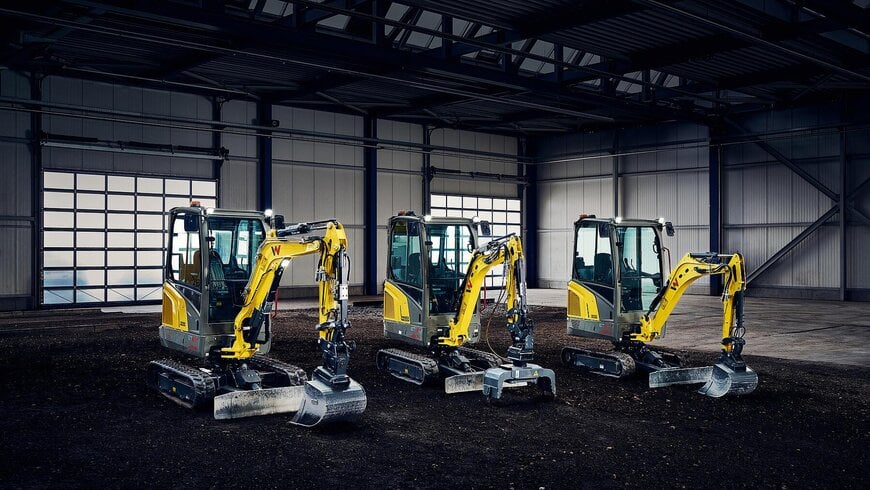
The transition toward electrified and precision-controlled construction equipment is driven by the requirement for localized zero-emission operation and improved mechanical accuracy. Wacker Neuson has expanded its portfolio with a redesigned generation of 2-ton class mini-excavators, an infrared-monitored trench roller, and battery-powered trowels designed for indoor concrete finishing. These technologies address specific technical challenges in urban infrastructure and industrial flooring where space constraints and air quality standards are primary operational variables.
Hydraulic Precision and Variable Undercarriage Geometry
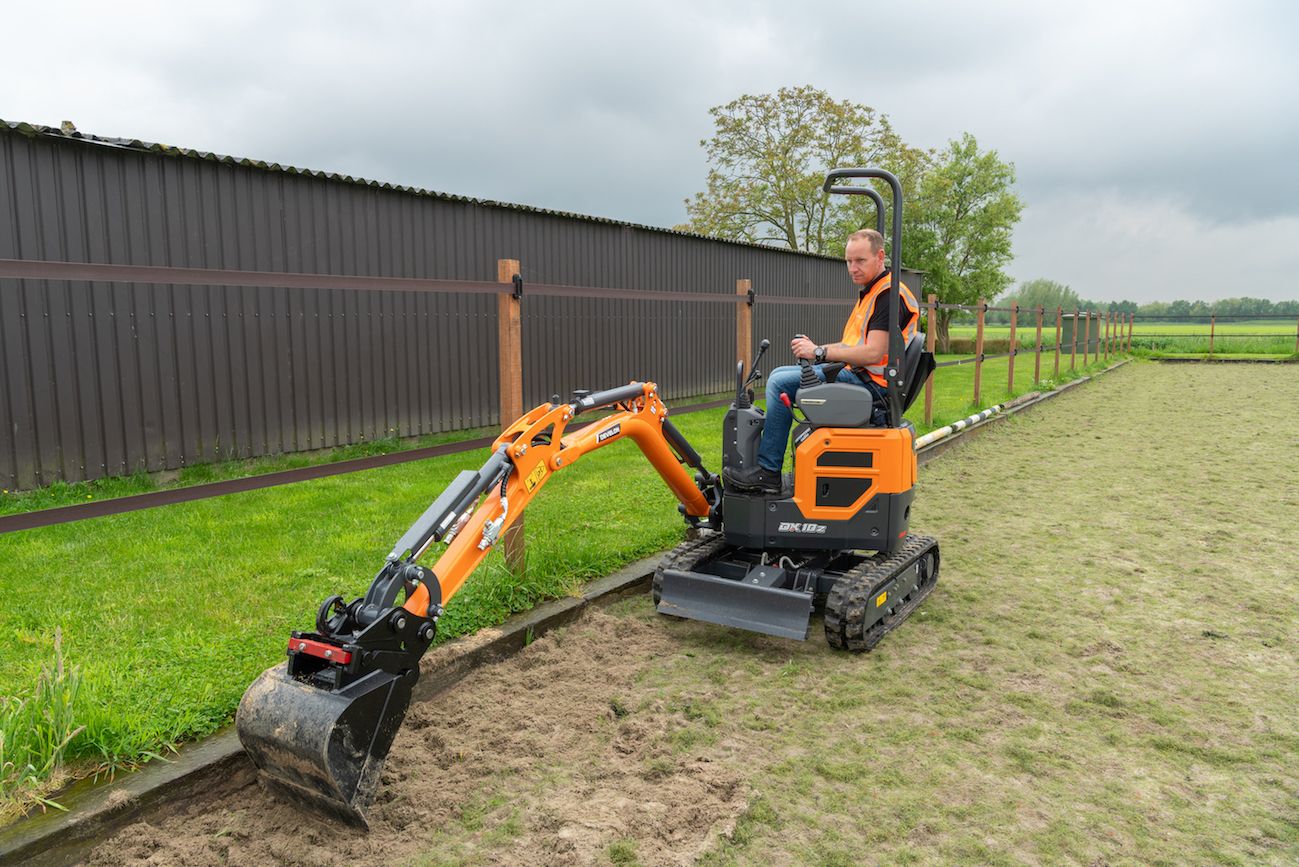
The ET18, ET20, and ET25 mini-excavators utilize a redesigned hydraulic architecture to manage complex task sequences. A primary technical feature in this class is the integration of parallel auxiliary control circuits. These circuits allow operators to toggle functions via joystick-mounted buttons, eliminating the need for manual mechanical switching. This configuration supports the simultaneous execution of multiple movements, providing the smooth flow required for excavating shafts or working along finished edges.
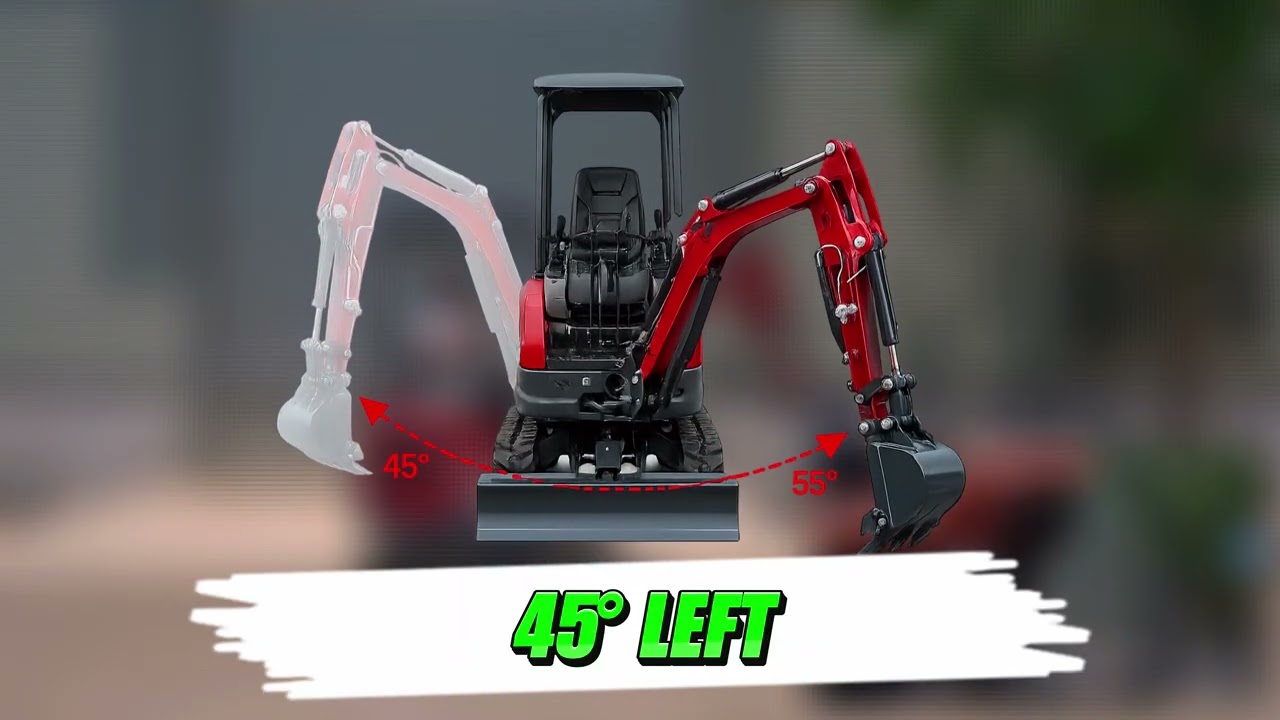
To navigate restricted access points within a digital supply chain of construction logistics, the ET18 and ET20 feature a hydraulically telescoping travel gear with a minimum width of 990 millimeters, while the ET25 maintains a minimum of 1100 millimeters. For applications on uneven gradients or curbs, the Vertical Digging System (VDS) provides continuously variable tilting of the upper carriage. This mechanism allows the operator to compensate for slopes, maintaining a vertical orientation for precise trenching.
Remote Infrastructure Compaction and Signal Redundancy
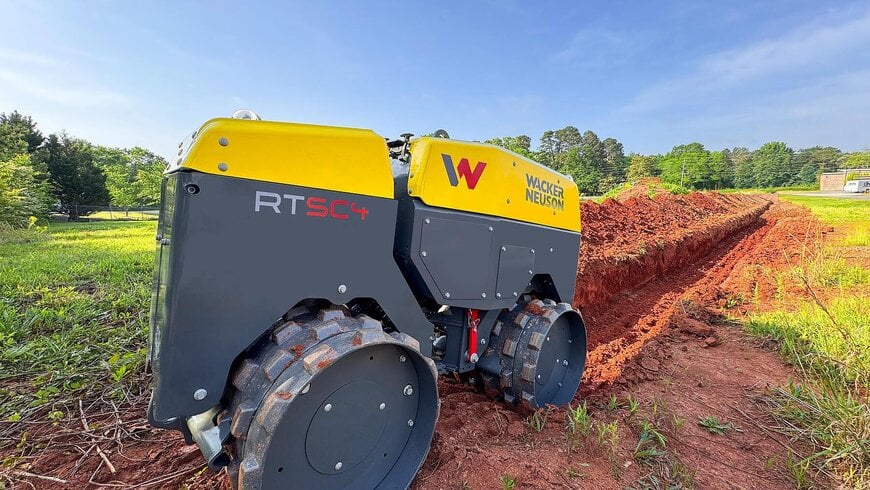
The new RT trench roller addresses safety and consistency in pipeline and utility construction. Adhering to the European Standard EN 474, the machine employs a dual-signal remote control system. It combines radio transmission for data stability with an infrared system for line-of-sight monitoring. If the infrared connection is obstructed—common in deep trenches or around building corners—the machine executes an automatic stop sequence to prevent unmonitored movement.
Operational consistency is managed through a patented return-to-center function, which mechanically resets the roller to a straight path without manual steering correction. From a maintenance perspective, the drive motor and drum-integrated vibration system are rated for 1,000 operating hours before requiring initial service. An integrated LED display provides real-time diagnostics and maintenance intervals, reducing unplanned downtime on high-utilization job sites.
Electrification of Interior Concrete Finishing
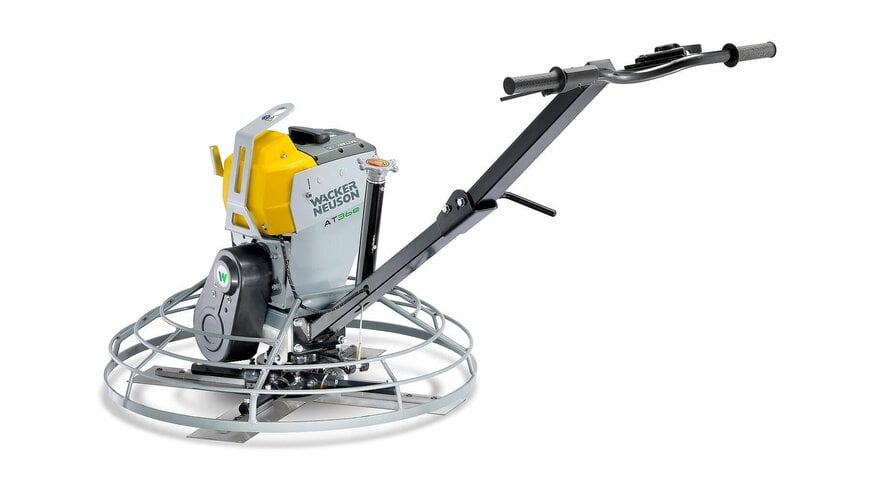
For industrial hall and parking garage construction, Wacker Neuson has introduced two sizes of battery-powered trowels. These units are engineered for indoor concrete smoothing where combustion engine exhaust is prohibited by safety regulations.
These electric trowels maintain the ergonomic handling characteristics of conventional models while removing the technical requirement for complex ventilation systems during the curing and finishing phases of concrete placement. By integrating these tools into the broader automotive data ecosystem of modern site management, contractors can better predict energy consumption and project timelines in regulated environments.
Edited by Evgeny Churilov, Induportals Media - Adapted by AI.
www.wackerneuson.co.uk
Powered by
Induportals Media Publishing