Rugged edge panel PCs optimize vision computing in heavy industrial automation
Sintrones introduces a vehicle-grade touch-screen platform equipped with system-on-module acceleration layers to sustain severe-duty field processing. www.sintrones.com Sintrones Technology Corporation has announced the market introduction of its VPC-101RB2S rugged edge AI panel PC engineered to optimize computer vision and interactive human-machine interfaces across highly unconditioned environments. This specialized platform integrates hardware-accelerated processing matrices with high-speed serialization interfaces developed to sustain multi-camera automated navigation, obstacle classification, and teleoperation loops within heavy utility vehicles. To ensure deterministic data collection under extreme atmospheric loads, the platform incorporates localized structural hardening layers alongside flexible power management blocks. Video capture interfaces and processing architecture configuration The physical architecture of severe-duty automation systems demands high-bandwidth vision ingest channels that operate without latency variation or frames dropping over extended connections. By incorporating up to four Gigabit Multimedia Serial Link 2 camera inputs, the design handles high-resolution video streams across single coaxial cables while feeding power back to the remote lenses. This localized serialization layout minimizes physical wiring cross-sections and isolates high-frequency signal packets from neighboring electromagnetic interference loops. The primary computation framework relies on interchangeable system-on-module engines, giving operators a choice between variable computing tiers. The configuration scales processing ceilings up to 157 tera-operations per second while tuning electrical load limits as low as 7 watts using runtime power profiling presets. This hardware acceleration layer runs parallelized neural network layers for threat classification, distributing tasks to internal processing blocks without generating heat buildup that could trigger emergency core throttling limits. Automated workload balancing across the computing architecture limits overall processor strain during multi-stream targeting cycles. Optical bonding mechanics and localized structural layout choices The interactive human-machine display uses a 10.1-inch panel equipped with specialized surface treatments to preserve clear sight lines under direct, unshaded sunlight. The layout implements optical bonding to eliminate air voids between the protective cover glass and the liquid-crystal layer, preventing internal condensation drops and shifting refraction coefficients to drop light loss reflections. This optimization is backed by anti-glare and anti-fingerprint matrices that stabilize touchscreen signal inputs even when operators wear protective gloves. The outer mechanical shell features localized structural protections rated up to IK08 impact resistances and IP66 sealing thresholds to protect delicate interior electronics from particle ingress and direct water spray. The system isolates electrical instabilities by running wide wide-input power regulators that accept voltage sweeps from 9 to 60 volts, stopping voltage dips from causing sudden reboots during heavy vehicle ignition cycles. Additionally, high-retention waterproof connectors secure peripheral linkages, and a top-accessible removable access tray lets maintenance teams swap the real-time clock backup battery without taking down the entire machine cabinet. These low-maintenance properties optimize long-term equipment up-times in remote testing sites. Additional Context: This section details technical specifications and competitive benchmarking not included in the original product announcement Within the heavy ruggedized computing and smart machine interface market, this series competes directly with established hardware configurations such as the VC-series vehicle terminals from Advantech or the rugged panel computers built by Nexcom International. Objective technical benchmarking demonstrates that while standard vehicular monitors require separate external computing enclosures connected via lengthy USB links—which limits total video ingestion speed and adds clutter to small cabin spaces—the Sintrones platform unifies the terminal and accelerator elements. This approach eliminates interconnect limits and stabilizes target tracking loops during active outdoor operations. Additionally, using modern 2.5-Gigabit Ethernet interfaces with optional power-over-Ethernet configurations helps the unit blend into existing plant networks and interface with network camera layouts. The integrated global navigation satellite system modules provide reliable global positioning context, enabling parallel processing of localized coordinates and automated object recognition. However, getting the full 157 TOPS of processing power during dense neural network loads depends on your thermal dissipation strategy. Operating near the upper 60 degrees Celsius environment limit can
 machineryasia
Sintrones introduces a vehicle-grade touch-screen platform equipped with system-on-module acceleration layers to sustain severe-duty field processing.
www.sintrones.com
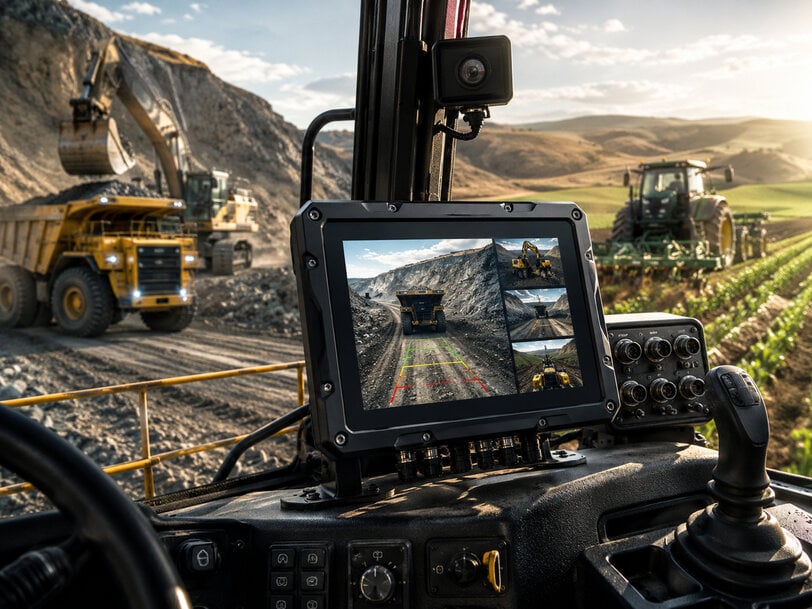
Sintrones Technology Corporation has announced the market introduction of its VPC-101RB2S rugged edge AI panel PC engineered to optimize computer vision and interactive human-machine interfaces across highly unconditioned environments. This specialized platform integrates hardware-accelerated processing matrices with high-speed serialization interfaces developed to sustain multi-camera automated navigation, obstacle classification, and teleoperation loops within heavy utility vehicles. To ensure deterministic data collection under extreme atmospheric loads, the platform incorporates localized structural hardening layers alongside flexible power management blocks.
Video capture interfaces and processing architecture configuration
The physical architecture of severe-duty automation systems demands high-bandwidth vision ingest channels that operate without latency variation or frames dropping over extended connections. By incorporating up to four Gigabit Multimedia Serial Link 2 camera inputs, the design handles high-resolution video streams across single coaxial cables while feeding power back to the remote lenses. This localized serialization layout minimizes physical wiring cross-sections and isolates high-frequency signal packets from neighboring electromagnetic interference loops.
The primary computation framework relies on interchangeable system-on-module engines, giving operators a choice between variable computing tiers. The configuration scales processing ceilings up to 157 tera-operations per second while tuning electrical load limits as low as 7 watts using runtime power profiling presets.
This hardware acceleration layer runs parallelized neural network layers for threat classification, distributing tasks to internal processing blocks without generating heat buildup that could trigger emergency core throttling limits. Automated workload balancing across the computing architecture limits overall processor strain during multi-stream targeting cycles.
Optical bonding mechanics and localized structural layout choices
The interactive human-machine display uses a 10.1-inch panel equipped with specialized surface treatments to preserve clear sight lines under direct, unshaded sunlight. The layout implements optical bonding to eliminate air voids between the protective cover glass and the liquid-crystal layer, preventing internal condensation drops and shifting refraction coefficients to drop light loss reflections. This optimization is backed by anti-glare and anti-fingerprint matrices that stabilize touchscreen signal inputs even when operators wear protective gloves.
The outer mechanical shell features localized structural protections rated up to IK08 impact resistances and IP66 sealing thresholds to protect delicate interior electronics from particle ingress and direct water spray. The system isolates electrical instabilities by running wide wide-input power regulators that accept voltage sweeps from 9 to 60 volts, stopping voltage dips from causing sudden reboots during heavy vehicle ignition cycles.
Additionally, high-retention waterproof connectors secure peripheral linkages, and a top-accessible removable access tray lets maintenance teams swap the real-time clock backup battery without taking down the entire machine cabinet. These low-maintenance properties optimize long-term equipment up-times in remote testing sites.
Additional Context: This section details technical specifications and competitive benchmarking not included in the original product announcement
Within the heavy ruggedized computing and smart machine interface market, this series competes directly with established hardware configurations such as the VC-series vehicle terminals from Advantech or the rugged panel computers built by Nexcom International. Objective technical benchmarking demonstrates that while standard vehicular monitors require separate external computing enclosures connected via lengthy USB links—which limits total video ingestion speed and adds clutter to small cabin spaces—the Sintrones platform unifies the terminal and accelerator elements. This approach eliminates interconnect limits and stabilizes target tracking loops during active outdoor operations.
Additionally, using modern 2.5-Gigabit Ethernet interfaces with optional power-over-Ethernet configurations helps the unit blend into existing plant networks and interface with network camera layouts. The integrated global navigation satellite system modules provide reliable global positioning context, enabling parallel processing of localized coordinates and automated object recognition.
However, getting the full 157 TOPS of processing power during dense neural network loads depends on your thermal dissipation strategy. Operating near the upper 60 degrees Celsius environment limit can cause localized heat buildup in the enclosure, making it necessary to carefully adjust your software power parameters compared to larger, active-chilled computing stations fitted with external fluid cooling loops.
The modular expansion framework allows system developers to confidently roll out advanced vision applications. By adjusting parameters to balance compute limits and thermal profiles, field teams can maintain network reliability in unpredictable field deployments.
Edited by Sucithra Mani, Induportals editor – adapted by AI.
www.sintrones.com
Powered by
Induportals Media Publishing