Mobile Crane Supports Hybrid Wind Tower Construction
Max Bögl Group deployed new mobile cranes to increase efficiency and support the growing demand for hybrid wind tower installation. www.liebherr.com Application areas: Wind turbine installation, heavy lifting, wind farm construction Industry sectors: Renewable energy, construction equipment, mobile cranes Growing demand for renewable energy infrastructure has increased the need for faster and more efficient wind turbine installation. As Germany's market and technology leader in hybrid wind turbine towers, the Max Bögl Group is expanding its production and assembly capacity to meet rising demand while maintaining installation quality and project schedules. To support this expansion, the company ordered five heavy-duty mobile cranes, with the first unit entering service during the construction of a wind farm in Papenburg, Germany. Lifting Challenges in Hybrid Tower Construction Hybrid wind turbine towers combine reinforced concrete and steel sections. The concrete portion alone consists of more than 30 precast rings and can reach heights of up to 110 metres, depending on the turbine design. Individual rings weigh up to 60 tonnes and measure up to 12 metres in diameter. Installing these components requires high lifting capacity, precise positioning and equipment capable of being relocated efficiently between construction sites. As turbine dimensions continue to increase, these operational requirements become more demanding. Selecting a Mobile Crane for Large-Scale Projects To address these requirements, Max Bögl selected the Liebherr LTM 1750-9.1 mobile crane for its hybrid tower assembly operations. According to Stefan Bögl, CEO of the Max Bögl Group, the company expanded its crane fleet to strengthen its vertically integrated construction capabilities and respond more effectively to increasing market demand for hybrid towers. He noted that the crane's high lifting capacity and rapid deployment make it well suited to wind farm construction projects. The mobile crane combines heavy lifting performance with relatively short setup times, allowing equipment to be transferred efficiently between multiple installation sites. Deployment at the Papenburg Wind Farm Following delivery from Liebherr's manufacturing facility in Ehingen, Germany, the first crane was transported to a wind farm project in Papenburg, near the Dutch border. The project requires the installation of 20 concrete wind turbine towers with a hub height of 164 metres over a planned construction period of 17 weeks. Each concrete tower reaches 86 metres in height. During assembly, the crane lifts concrete elements weighing up to 56 tonnes. Its 52-metre telescopic boom is extended with lattice sections to achieve a roller head height of approximately 100 metres, enabling the placement of heavy tower segments at significant elevations. Florian Herdegen, Site Manager for Tower Assembly at Max Bögl, explained that increasing turbine sizes require appropriately sized lifting equipment. He added that precise positioning of the concrete rings under changing weather conditions remains a demanding task and that the crane supports a smooth installation process. Supporting Higher Productivity in Wind Farm Construction The deployment demonstrates how equipment selection contributes to improved project execution in large-scale renewable energy construction. The crane's combination of lifting capacity, mobility and fast setup enables Max Bögl to handle heavier tower components while reducing time between projects. These characteristics support efficient resource utilisation as the company expands its wind turbine installation capacity. The remaining four mobile cranes are scheduled for delivery in stages by February 2027, further increasing the company's ability to support hybrid tower construction projects. Edited by Sucithra Mani, Induportals editor – adapted by AI. www.liebherr.com Powered by Induportals Media Publishing
 machineryasia
Max Bögl Group deployed new mobile cranes to increase efficiency and support the growing demand for hybrid wind tower installation.
www.liebherr.com
Application areas: Wind turbine installation, heavy lifting, wind farm construction
Industry sectors: Renewable energy, construction equipment, mobile cranes
Growing demand for renewable energy infrastructure has increased the need for faster and more efficient wind turbine installation. As Germany's market and technology leader in hybrid wind turbine towers, the Max Bögl Group is expanding its production and assembly capacity to meet rising demand while maintaining installation quality and project schedules.
To support this expansion, the company ordered five heavy-duty mobile cranes, with the first unit entering service during the construction of a wind farm in Papenburg, Germany.
Lifting Challenges in Hybrid Tower Construction
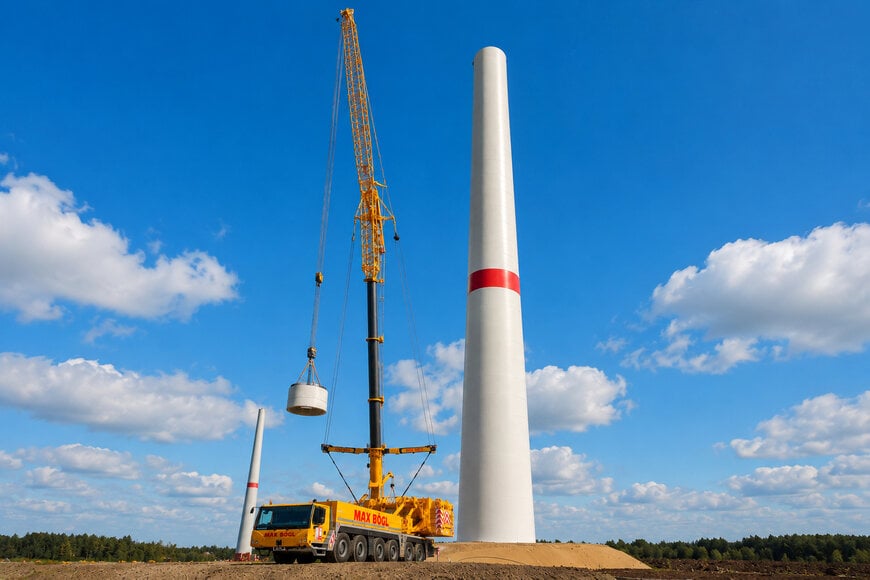
Hybrid wind turbine towers combine reinforced concrete and steel sections. The concrete portion alone consists of more than 30 precast rings and can reach heights of up to 110 metres, depending on the turbine design. Individual rings weigh up to 60 tonnes and measure up to 12 metres in diameter.
Installing these components requires high lifting capacity, precise positioning and equipment capable of being relocated efficiently between construction sites. As turbine dimensions continue to increase, these operational requirements become more demanding.
Selecting a Mobile Crane for Large-Scale Projects
To address these requirements, Max Bögl selected the Liebherr LTM 1750-9.1 mobile crane for its hybrid tower assembly operations.
According to Stefan Bögl, CEO of the Max Bögl Group, the company expanded its crane fleet to strengthen its vertically integrated construction capabilities and respond more effectively to increasing market demand for hybrid towers. He noted that the crane's high lifting capacity and rapid deployment make it well suited to wind farm construction projects.
The mobile crane combines heavy lifting performance with relatively short setup times, allowing equipment to be transferred efficiently between multiple installation sites.
Deployment at the Papenburg Wind Farm
Following delivery from Liebherr's manufacturing facility in Ehingen, Germany, the first crane was transported to a wind farm project in Papenburg, near the Dutch border.
The project requires the installation of 20 concrete wind turbine towers with a hub height of 164 metres over a planned construction period of 17 weeks. Each concrete tower reaches 86 metres in height.
During assembly, the crane lifts concrete elements weighing up to 56 tonnes. Its 52-metre telescopic boom is extended with lattice sections to achieve a roller head height of approximately 100 metres, enabling the placement of heavy tower segments at significant elevations.
Florian Herdegen, Site Manager for Tower Assembly at Max Bögl, explained that increasing turbine sizes require appropriately sized lifting equipment. He added that precise positioning of the concrete rings under changing weather conditions remains a demanding task and that the crane supports a smooth installation process.
Supporting Higher Productivity in Wind Farm Construction
The deployment demonstrates how equipment selection contributes to improved project execution in large-scale renewable energy construction.
The crane's combination of lifting capacity, mobility and fast setup enables Max Bögl to handle heavier tower components while reducing time between projects. These characteristics support efficient resource utilisation as the company expands its wind turbine installation capacity.
The remaining four mobile cranes are scheduled for delivery in stages by February 2027, further increasing the company's ability to support hybrid tower construction projects.
Edited by Sucithra Mani, Induportals editor – adapted by AI.
www.liebherr.com
Powered by
Induportals Media Publishing