Mobile Crane Expands Mid-Capacity Lifting Operations
Liebherr supplied a four-axle 90-tonne crane to support compact heavy-lifting applications requiring high reach and reduced transport complexity. www.liebherr.com Arbeitsbühnen Gagarin GmbH has expanded its lifting fleet with its first Liebherr mobile crane, adding a 90-tonne all-terrain model designed to bridge the gap between its existing 60-tonne and 100-tonne crane classes. The investment reflects growing demand for compact lifting equipment capable of handling heavier loads without the transport restrictions often associated with larger crane categories. The new crane will support applications across steel construction, industrial maintenance, prefabricated building installation, and tower crane assembly, where lifting performance, site accessibility, and transport flexibility are critical operational requirements. Fleet Expansion Addresses Demand for Compact High-Capacity Cranes The crane acquisition follows increased demand for lifting equipment that combines high load capacity with simplified road transport logistics. According to Arbeitsbühnen Gagarin GmbH, customers increasingly require cranes capable of handling demanding lifting tasks while avoiding the permitting procedures and transport planning associated with heavier crane configurations. The company selected the Liebherr LTM 1090-4.2, a four-axle all-terrain crane with a maximum lifting capacity of 90 tonnes. The model occupies a position between traditional 60-tonne and 100-tonne crane classes, enabling operators to perform heavier lifts without moving to substantially larger equipment. This approach can improve fleet utilization and reduce deployment complexity for construction and industrial projects. The investment forms part of a broader capacity expansion strategy rather than a replacement of existing equipment, reflecting a growing project pipeline and increasing requirements for lifting height and operational flexibility. Four-Axle Crane Architecture Balances Reach and Mobility A key factor in the crane selection was its combination of lifting performance and transport mobility. The LTM 1090-4.2 features a 60-meter telescopic boom, a maximum lifting capacity of 90 tonnes, a maximum hoist height of 76 meters, and a maximum operating radius of 62 meters, while maintaining a four-axle configuration suitable for road transport. The crane is designed to provide lifting capabilities approaching larger crane classes while preserving maneuverability on urban and space-constrained construction sites. This configuration is particularly relevant for infrastructure projects, industrial facilities, and building construction where access limitations can restrict the use of larger lifting equipment. By positioning the crane between smaller mobile units and higher-capacity models, Arbeitsbühnen Gagarin GmbH aims to improve flexibility across a wider range of lifting scenarios without significantly increasing transport complexity. Variable Outrigger and Ballast Systems Improve Site Adaptability The LTM 1090-4.2 incorporates several Liebherr technologies intended to improve lifting performance in restricted working environments. One of these systems is VarioBase®, which allows each outrigger to be extended independently. The crane control system calculates permissible load capacities according to the actual support configuration, helping maintain stability when obstacles prevent symmetrical outrigger deployment. The crane also includes the VarioBallast® system, which enables operators to adjust the ballast radius according to site conditions. In confined spaces, the counterweight radius can be reduced while maintaining operational flexibility. This feature is intended to improve lifting performance where surrounding structures limit available operating space. Together, these systems support lifting operations on urban construction sites, factory facilities, and industrial plants where available setup space is often restricted. Fuel Efficiency and Operational Performance Features The crane utilizes Liebherr's ECOdrive and ECOmode systems, which are designed to reduce fuel consumption and lower noise emissions during both travel and lifting operations. ECOdrive optimizes engine speed and transmission behavior during vehicle movement, while ECOmode automatically adjusts engine performance according to lifting demand. The machine also employs a single-engine architecture in which the carrier engine powers both the vehicle and crane superstructure. Eliminating a second engine reduces maintenance requirements and lowers overall vehicle weight while supporting improved transport efficiency. These features are increasingly relevant for construction projects operating within environmental restrictions, urban noise regulations, and sustainability-focused procurement frameworks across the digital supply chain of modern infrastructure development. Industrial and Construction Application Requirements Arbeitsbühnen Gagarin GmbH plans to deploy
 machineryasia
Liebherr supplied a four-axle 90-tonne crane to support compact heavy-lifting applications requiring high reach and reduced transport complexity.
www.liebherr.com
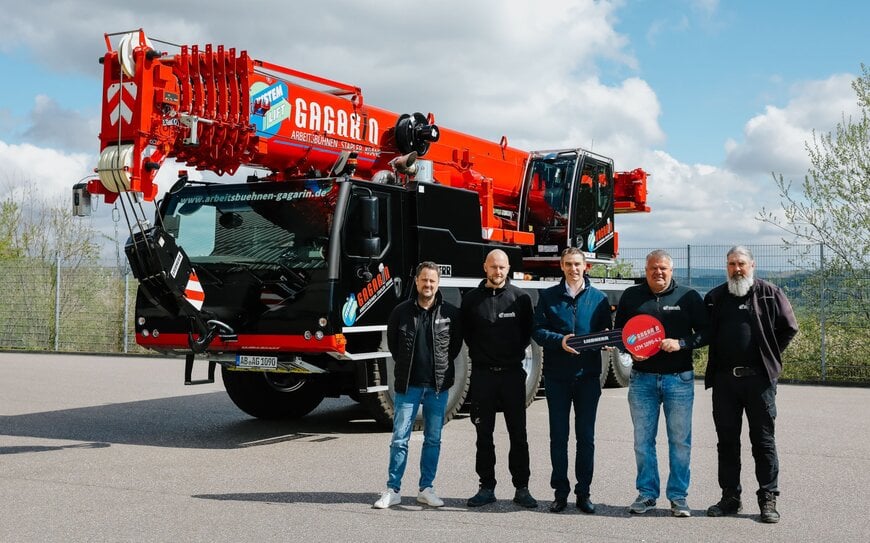
Arbeitsbühnen Gagarin GmbH has expanded its lifting fleet with its first Liebherr mobile crane, adding a 90-tonne all-terrain model designed to bridge the gap between its existing 60-tonne and 100-tonne crane classes. The investment reflects growing demand for compact lifting equipment capable of handling heavier loads without the transport restrictions often associated with larger crane categories.
The new crane will support applications across steel construction, industrial maintenance, prefabricated building installation, and tower crane assembly, where lifting performance, site accessibility, and transport flexibility are critical operational requirements.
Fleet Expansion Addresses Demand for Compact High-Capacity Cranes
The crane acquisition follows increased demand for lifting equipment that combines high load capacity with simplified road transport logistics. According to Arbeitsbühnen Gagarin GmbH, customers increasingly require cranes capable of handling demanding lifting tasks while avoiding the permitting procedures and transport planning associated with heavier crane configurations.
The company selected the Liebherr LTM 1090-4.2, a four-axle all-terrain crane with a maximum lifting capacity of 90 tonnes. The model occupies a position between traditional 60-tonne and 100-tonne crane classes, enabling operators to perform heavier lifts without moving to substantially larger equipment. This approach can improve fleet utilization and reduce deployment complexity for construction and industrial projects.
The investment forms part of a broader capacity expansion strategy rather than a replacement of existing equipment, reflecting a growing project pipeline and increasing requirements for lifting height and operational flexibility.
Four-Axle Crane Architecture Balances Reach and Mobility
A key factor in the crane selection was its combination of lifting performance and transport mobility. The LTM 1090-4.2 features a 60-meter telescopic boom, a maximum lifting capacity of 90 tonnes, a maximum hoist height of 76 meters, and a maximum operating radius of 62 meters, while maintaining a four-axle configuration suitable for road transport.
The crane is designed to provide lifting capabilities approaching larger crane classes while preserving maneuverability on urban and space-constrained construction sites. This configuration is particularly relevant for infrastructure projects, industrial facilities, and building construction where access limitations can restrict the use of larger lifting equipment.
By positioning the crane between smaller mobile units and higher-capacity models, Arbeitsbühnen Gagarin GmbH aims to improve flexibility across a wider range of lifting scenarios without significantly increasing transport complexity.
Variable Outrigger and Ballast Systems Improve Site Adaptability
The LTM 1090-4.2 incorporates several Liebherr technologies intended to improve lifting performance in restricted working environments. One of these systems is VarioBase®, which allows each outrigger to be extended independently. The crane control system calculates permissible load capacities according to the actual support configuration, helping maintain stability when obstacles prevent symmetrical outrigger deployment.
The crane also includes the VarioBallast® system, which enables operators to adjust the ballast radius according to site conditions. In confined spaces, the counterweight radius can be reduced while maintaining operational flexibility. This feature is intended to improve lifting performance where surrounding structures limit available operating space.
Together, these systems support lifting operations on urban construction sites, factory facilities, and industrial plants where available setup space is often restricted.
Fuel Efficiency and Operational Performance Features
The crane utilizes Liebherr's ECOdrive and ECOmode systems, which are designed to reduce fuel consumption and lower noise emissions during both travel and lifting operations. ECOdrive optimizes engine speed and transmission behavior during vehicle movement, while ECOmode automatically adjusts engine performance according to lifting demand.
The machine also employs a single-engine architecture in which the carrier engine powers both the vehicle and crane superstructure. Eliminating a second engine reduces maintenance requirements and lowers overall vehicle weight while supporting improved transport efficiency.
These features are increasingly relevant for construction projects operating within environmental restrictions, urban noise regulations, and sustainability-focused procurement frameworks across the digital supply chain of modern infrastructure development.
Industrial and Construction Application Requirements
Arbeitsbühnen Gagarin GmbH plans to deploy the crane across several sectors requiring high lifting capacity within constrained operating environments. Planned applications include steel and hall construction, prefabricated house installation, industrial maintenance work inside factory facilities, and tower crane erection.
These project categories often require a combination of extended boom reach, high lifting capacity, and rapid deployment. The crane's 60-meter telescopic boom and four-axle design allow operators to access construction sites that may not accommodate larger all-terrain crane configurations while still supporting heavier lifting requirements.
The addition increases the company's mobile crane fleet to four units, alongside a truck-mounted loader crane, supporting a broader range of lifting and material-handling services.
The fleet expansion aligns with broader industry trends toward flexible lifting solutions capable of supporting construction, logistics, and industrial projects requiring higher lifting capacities without transitioning to significantly larger crane classes.
Edited by Aishwarya Mambet, Induportals Editor, with AI assistance.
www.liebherr.com
Powered by
Induportals Media Publishing