Mobile Crane Deployment for High-Precision Precast Concrete Installation
Kuiphuis Kraanverhuur utilized a Liebherr six-axle 450-tonne lifting system to navigate confined site access and accurately position a heavy structural foundation. www.liebherr.com Kuiphuis Kraanverhuur partnered with heavy equipment manufacturer Liebherr to deploy a new 450-tonne mobile crane for a demanding precast concrete installation case study. This heavy lifting operation demonstrates the application of compact, high-capacity machinery for navigating constrained urban construction sites and executing single-lift placements of large structural elements. Site Constraints and Operational Challenges Kuiphuis Kraanverhuur required a method to install a precast basement element weighing 73 tonnes, measuring 12 meters in length, 4.6 meters in width, and 3 meters in height. The operation took place at a construction site in Oldenzaal, Netherlands. The location presented significant access limitations, including an approach route consisting of a road just three meters wide featuring a tight bend. Furthermore, the designated lifting area on raised ground allowed only 11 meters of clearance between the edge of the excavation pit and the machine's outriggers. This environment necessitated lifting equipment that combined high lifting capacity with compact physical dimensions and maneuverability. Equipment Selection and Pre-Lift Planning To address the combination of spatial restrictions and heavy load requirements, the contractor selected the Liebherr LTM 1400-6.1 mobile crane. The preparatory phase relied heavily on digital simulation using the Liebherr Crane Planner 2.0 software. This allowed the operations team to review various crane configurations and mathematically confirm the machine's suitability before deployment. Engineers also individually designed all slings using specialized calculation software. Because the confined excavation pit left no room for subsequent adjustments, the 73-tonne load had to be lifted directly from the transport vehicle and lowered into its final position in one uninterrupted motion. Technical Execution and Load Management For the execution of the lift, the six-axle crane was configured with 130 tonnes of counterweight, and its telescopic boom was extended to 19.8 meters. Operating at a working radius of 13.5 meters, the system successfully managed a total gross load of 75.2 tonnes, which included the concrete structure, hook block, and rigging slings. As the precast element was slewed across the crane's axis, operators utilized the machine's variable ballast system. By dynamically adjusting the ballast radius, the operators maintained optimal structural stability while lowering the load into the pit in a controlled manner. Manufacturer Support and Deployment Outcomes The project served as the initial deployment for this specific machine, taking place shortly after its delivery. Liebherr supported the technical integration by providing dedicated operator training alongside on-site technical assistance during the lift. The careful preparatory calculations allowed the operating team to successfully execute the placement without site delays or risks to the surrounding infrastructure. Bart Welhuis, operations planner at Kuiphuis Kraanverhuur, emphasized the technical necessity of the planning phase, noting that the foundation had to be moved into its final position in a single lift. Following this deployment, the contractor intends to use the mobile crane system for assembling and dismantling tower cranes, wind energy infrastructure projects, and industrial machinery relocation. Edited by Aishwarya Mambet, Induportals Editor, with AI assistance. www.liebherr.com Powered by Induportals Media Publishing
 machineryasia
Kuiphuis Kraanverhuur utilized a Liebherr six-axle 450-tonne lifting system to navigate confined site access and accurately position a heavy structural foundation.
www.liebherr.com
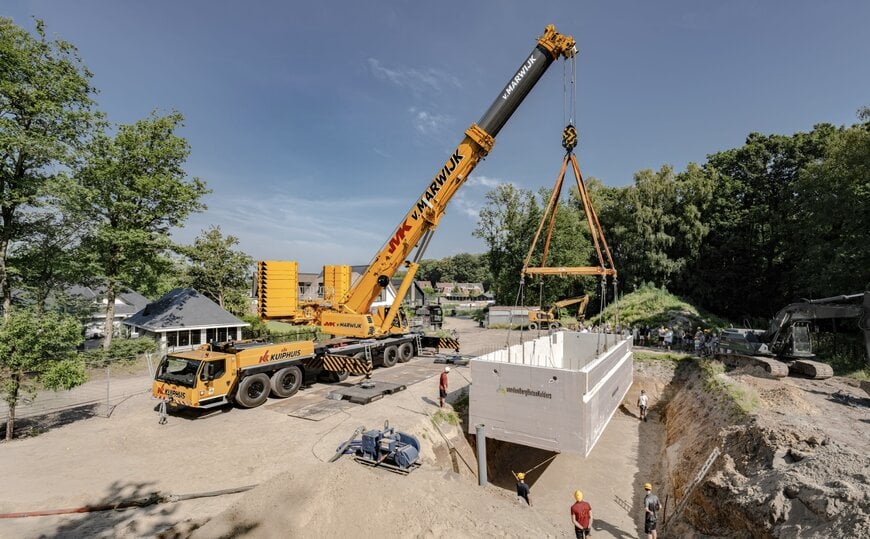
Kuiphuis Kraanverhuur partnered with heavy equipment manufacturer Liebherr to deploy a new 450-tonne mobile crane for a demanding precast concrete installation case study. This heavy lifting operation demonstrates the application of compact, high-capacity machinery for navigating constrained urban construction sites and executing single-lift placements of large structural elements.
Site Constraints and Operational Challenges
Kuiphuis Kraanverhuur required a method to install a precast basement element weighing 73 tonnes, measuring 12 meters in length, 4.6 meters in width, and 3 meters in height. The operation took place at a construction site in Oldenzaal, Netherlands. The location presented significant access limitations, including an approach route consisting of a road just three meters wide featuring a tight bend. Furthermore, the designated lifting area on raised ground allowed only 11 meters of clearance between the edge of the excavation pit and the machine's outriggers. This environment necessitated lifting equipment that combined high lifting capacity with compact physical dimensions and maneuverability.
Equipment Selection and Pre-Lift Planning
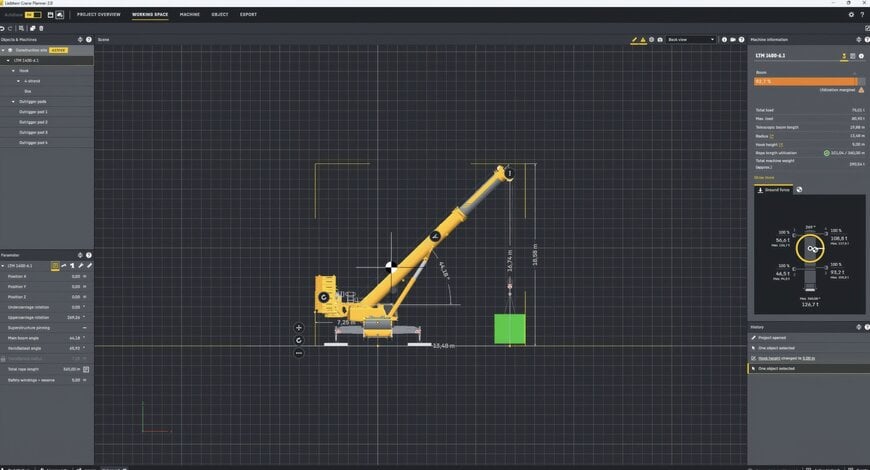
To address the combination of spatial restrictions and heavy load requirements, the contractor selected the Liebherr LTM 1400-6.1 mobile crane. The preparatory phase relied heavily on digital simulation using the Liebherr Crane Planner 2.0 software. This allowed the operations team to review various crane configurations and mathematically confirm the machine's suitability before deployment. Engineers also individually designed all slings using specialized calculation software. Because the confined excavation pit left no room for subsequent adjustments, the 73-tonne load had to be lifted directly from the transport vehicle and lowered into its final position in one uninterrupted motion.
Technical Execution and Load Management
For the execution of the lift, the six-axle crane was configured with 130 tonnes of counterweight, and its telescopic boom was extended to 19.8 meters. Operating at a working radius of 13.5 meters, the system successfully managed a total gross load of 75.2 tonnes, which included the concrete structure, hook block, and rigging slings. As the precast element was slewed across the crane's axis, operators utilized the machine's variable ballast system. By dynamically adjusting the ballast radius, the operators maintained optimal structural stability while lowering the load into the pit in a controlled manner.
Manufacturer Support and Deployment Outcomes
The project served as the initial deployment for this specific machine, taking place shortly after its delivery. Liebherr supported the technical integration by providing dedicated operator training alongside on-site technical assistance during the lift. The careful preparatory calculations allowed the operating team to successfully execute the placement without site delays or risks to the surrounding infrastructure. Bart Welhuis, operations planner at Kuiphuis Kraanverhuur, emphasized the technical necessity of the planning phase, noting that the foundation had to be moved into its final position in a single lift. Following this deployment, the contractor intends to use the mobile crane system for assembling and dismantling tower cranes, wind energy infrastructure projects, and industrial machinery relocation.
Edited by Aishwarya Mambet, Induportals Editor, with AI assistance.
www.liebherr.com
Powered by
Induportals Media Publishing