MK 140‑5.1E masters roof installations for DB mega project in Cottbus
For over two years, a Liebherr MK 140-5.1E mobile construction crane has reliably lifted essential components at Germany’s largest ICE maintenance depot project in Cottbus. www.liebherr.com Deutsche Bahn is undertaking a large-scale rail infrastructure project in Cottbus, involving the construction and installation of complex roof structures within an active railway environment. The project required precise lifting operations under spatial constraints, with limited setup areas and strict safety requirements due to proximity to rail lines and existing structures. The operational challenge was to install heavy prefabricated roof elements efficiently while minimizing site disruption, reducing setup time, and maintaining high positioning accuracy. Conventional crane configurations would have required extensive assembly space and longer mobilization times, conflicting with the project’s logistical constraints. Selection of a mobile tower crane solution To address these requirements, a mobile tower crane from Liebherr was selected. The crane combines the mobility of a mobile crane with the vertical reach and precision of a tower crane, making it suitable for urban or infrastructure environments with restricted footprints. The chosen configuration enabled rapid deployment without the need for extensive auxiliary equipment. Its telescopic tower design allowed the crane to achieve the necessary hook height while maintaining stability within a compact setup area. This was a decisive factor for operations near active railway lines, where minimizing ground occupation is critical. Deployment and operational support The crane was deployed directly on-site with minimal assembly, allowing lifting operations to begin shortly after arrival. This reduced downtime between transport and operation phases compared to conventional tower cranes, which typically require longer installation procedures. Liebherr supported the deployment by ensuring the crane configuration matched the load requirements and site constraints. This included planning lift sequences and optimizing crane positioning to cover multiple installation zones without frequent repositioning. Execution of roof installations During the project, the crane was used to lift and position large roof components with high precision. The vertical lifting capability and fine control systems enabled accurate placement, which is critical when installing prefabricated structural elements that must align precisely with supporting frameworks. The crane’s design also allowed for efficient operation in tight spaces, reducing the need for additional lifting equipment or complex logistics. This contributed to smoother workflow coordination across different construction phases. Operational outcomes The deployment of the mobile tower crane resulted in improved installation efficiency and reduced site complexity. Faster setup and dismantling phases minimized interruptions to the broader construction schedule. From an operational standpoint, the solution reduced the need for large assembly zones and additional support cranes, streamlining site organization. The precision of the lifting operations also helped limit rework during installation, contributing to overall project reliability. In the context of rail infrastructure construction, where access, safety, and scheduling constraints are tightly interlinked, the use of a mobile tower crane provided a balanced approach between flexibility, performance, and spatial efficiency. www.liebherr.com Powered by Induportals Media Publishing
 machineryasia
For over two years, a Liebherr MK 140-5.1E mobile construction crane has reliably lifted essential components at Germany’s largest ICE maintenance depot project in Cottbus.
www.liebherr.com
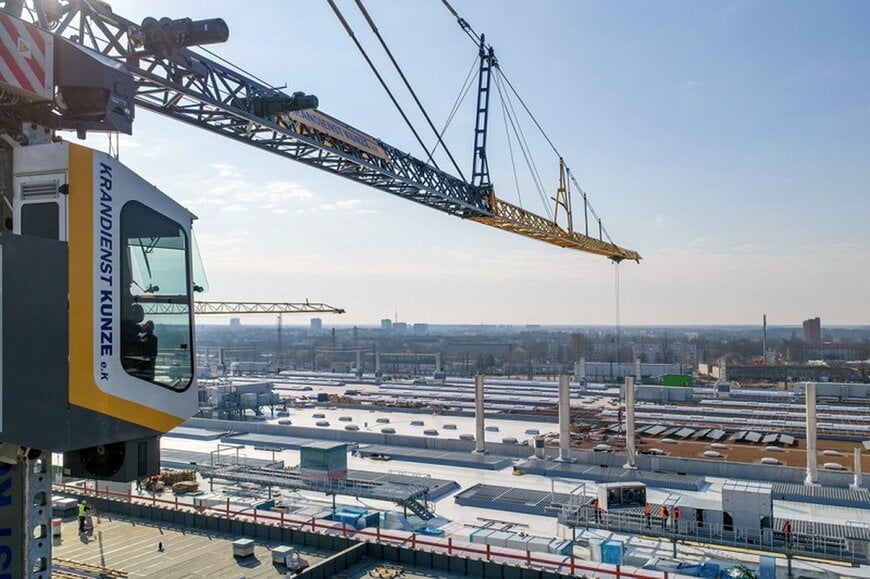
Deutsche Bahn is undertaking a large-scale rail infrastructure project in Cottbus, involving the construction and installation of complex roof structures within an active railway environment. The project required precise lifting operations under spatial constraints, with limited setup areas and strict safety requirements due to proximity to rail lines and existing structures.
The operational challenge was to install heavy prefabricated roof elements efficiently while minimizing site disruption, reducing setup time, and maintaining high positioning accuracy. Conventional crane configurations would have required extensive assembly space and longer mobilization times, conflicting with the project’s logistical constraints.
Selection of a mobile tower crane solution
To address these requirements, a mobile tower crane from Liebherr was selected. The crane combines the mobility of a mobile crane with the vertical reach and precision of a tower crane, making it suitable for urban or infrastructure environments with restricted footprints.
The chosen configuration enabled rapid deployment without the need for extensive auxiliary equipment. Its telescopic tower design allowed the crane to achieve the necessary hook height while maintaining stability within a compact setup area. This was a decisive factor for operations near active railway lines, where minimizing ground occupation is critical.
Deployment and operational support
The crane was deployed directly on-site with minimal assembly, allowing lifting operations to begin shortly after arrival. This reduced downtime between transport and operation phases compared to conventional tower cranes, which typically require longer installation procedures.
Liebherr supported the deployment by ensuring the crane configuration matched the load requirements and site constraints. This included planning lift sequences and optimizing crane positioning to cover multiple installation zones without frequent repositioning.
Execution of roof installations
During the project, the crane was used to lift and position large roof components with high precision. The vertical lifting capability and fine control systems enabled accurate placement, which is critical when installing prefabricated structural elements that must align precisely with supporting frameworks.
The crane’s design also allowed for efficient operation in tight spaces, reducing the need for additional lifting equipment or complex logistics. This contributed to smoother workflow coordination across different construction phases.
Operational outcomes
The deployment of the mobile tower crane resulted in improved installation efficiency and reduced site complexity. Faster setup and dismantling phases minimized interruptions to the broader construction schedule. From an operational standpoint, the solution reduced the need for large assembly zones and additional support cranes, streamlining site organization. The precision of the lifting operations also helped limit rework during installation, contributing to overall project reliability.
In the context of rail infrastructure construction, where access, safety, and scheduling constraints are tightly interlinked, the use of a mobile tower crane provided a balanced approach between flexibility, performance, and spatial efficiency.
www.liebherr.com
Powered by
Induportals Media Publishing