Deep Geological Repository Excavation for Nuclear Waste
Hyundai E&C has verified mechanical deposition hole excavation equipment at full scale in crystalline bedrock to advance high-level radioactive waste repository construction. www.hyundaimotorgroup.com Long-term containment of spent nuclear fuel requires deep geological repositories constructed hundreds of meters underground within stable crystalline rock formations. Within these facilities, deposition holes drilled into the floor of disposal tunnels house the engineered canisters containing high-level radioactive waste, surrounded by bentonite buffer materials. Maintaining the structural integrity of the surrounding host rock during drilling is critical to containment performance. Standard mechanical blasting or high-vibration drilling can induce an excavation damaged zone (EDZ) characterized by micro-fractures, which could create preferential pathways for groundwater migration and compromise radionuclide isolation over multi-millennial design horizons. Precision Underground Excavation Mechanics To address strict geological damage constraints, Hyundai E&C developed dedicated mechanical excavation machinery engineered specifically for deep disposal tunnels. Participating as the sole construction contractor in a research initiative led by the Korea Radioactive Waste Agency (KORAD), the company designed the mechanical drill assembly through the HMG Construction Technology Research Institute. The machine measures 1.75 meters in diameter and 5.7 meters in length, directly matching the dimensional and spatial tolerances specified by the Korea Advanced Disposal System (KORADIS) disposal concept. A central mechanical feature of the boring machine is its foldable cutterhead assembly. In production-scale repository environments, hundreds of vertical deposition holes must be drilled systematically along narrow disposal galleries without damaging the gallery ceiling or walls. The folding cutterhead mechanism retracts its diameter once target depth is achieved, allowing the full drill unit to be extracted vertically without disturbing the borehole collar, facilitating rapid repositioning for cyclic excavation sequences. Sensor Integration and Borehole Quality Assurance Verification trials took place in an underground research demonstration tunnel, where the machine bored an actual full-scale deposition hole directly into native bedrock. The system integrated artificial intelligence algorithms to process mechanical feedback, cutterhead thrust, and torque data in real time. Continuous monitoring enabled dynamic adjustments to drilling speed and contact pressure according to localized rock mass conditions, thereby minimizing mechanical shock and preventing excessive fracture propagation into the rock wall. Following mechanical excavation, technicians performed post-excavation dimensional verification using LiDAR-based digital surface mapping. High-density point clouds mapped the interior perimeter of the hole to evaluate wall verticality, surface roughness, and dimensional deviations relative to KORADIS installation tolerances. Engineered Barrier Systems and Geotechnical Monitoring Mechanical excavation forms one part of a multi-barrier containment infrastructure. Hyundai E&C is pairing mechanical borehole development with material formulation and rock mechanics engineering. Research teams are developing specialized low-pH concrete and low-permeability cementitious grouts designed to limit groundwater inflow into disposal drifts while preventing the chemical degradation of adjacent bentonite clay buffers. Parallel geotechnical programs focus on rock mass classification systems adapted to local geological features, alongside digital rock assessment technologies that track hydrological and mechanical changes within host rock across the repository lifecycle. Additional Context This section details technical specifications and competitive benchmarking not included in the original product announcement. Global deep geological repositories, including Posiva's Onkalo repository in Finland and SKB's planned facility at Forsmark in Sweden, rely on the KBS-3 multi-barrier disposal concept. In the KBS-3V vertical variant, mechanical boring methods such as vertical shaft boring machines and modified blind hole drill units serve as the international benchmark to control excavation damage zone thickness to strictly defined sub-centimeter limits. The dimensional standard verified by Hyundai E&C (1.75 meters diameter) matches the physical envelope required for standard disposal canisters surrounded by compacted bentonite buffer rings. Regulatory standards for nuclear waste disposal governed by the International Atomic Energy Agency (IAEA SSR-5) mandate that underground drilling techniques prevent micro-cracking capable of altering local groundwater hydrogeology. Development of specialized domestic excavation equipment with real-time digital monitoring addresses the mechanical and regulatory constraints established by global under
 machineryasia
Hyundai E&C has verified mechanical deposition hole excavation equipment at full scale in crystalline bedrock to advance high-level radioactive waste repository construction.
www.hyundaimotorgroup.com
Long-term containment of spent nuclear fuel requires deep geological repositories constructed hundreds of meters underground within stable crystalline rock formations. Within these facilities, deposition holes drilled into the floor of disposal tunnels house the engineered canisters containing high-level radioactive waste, surrounded by bentonite buffer materials. Maintaining the structural integrity of the surrounding host rock during drilling is critical to containment performance. Standard mechanical blasting or high-vibration drilling can induce an excavation damaged zone (EDZ) characterized by micro-fractures, which could create preferential pathways for groundwater migration and compromise radionuclide isolation over multi-millennial design horizons.
Precision Underground Excavation Mechanics
To address strict geological damage constraints, Hyundai E&C developed dedicated mechanical excavation machinery engineered specifically for deep disposal tunnels. Participating as the sole construction contractor in a research initiative led by the Korea Radioactive Waste Agency (KORAD), the company designed the mechanical drill assembly through the HMG Construction Technology Research Institute.
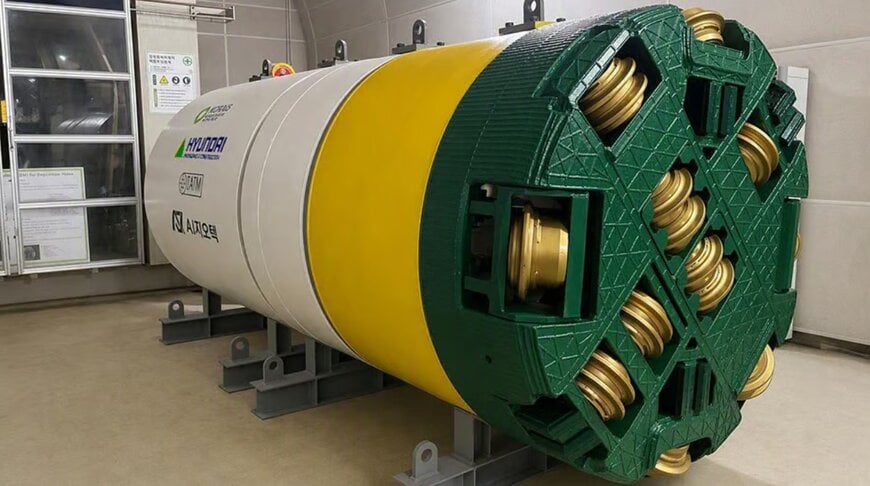
The machine measures 1.75 meters in diameter and 5.7 meters in length, directly matching the dimensional and spatial tolerances specified by the Korea Advanced Disposal System (KORADIS) disposal concept. A central mechanical feature of the boring machine is its foldable cutterhead assembly. In production-scale repository environments, hundreds of vertical deposition holes must be drilled systematically along narrow disposal galleries without damaging the gallery ceiling or walls. The folding cutterhead mechanism retracts its diameter once target depth is achieved, allowing the full drill unit to be extracted vertically without disturbing the borehole collar, facilitating rapid repositioning for cyclic excavation sequences.
Sensor Integration and Borehole Quality Assurance
Verification trials took place in an underground research demonstration tunnel, where the machine bored an actual full-scale deposition hole directly into native bedrock. The system integrated artificial intelligence algorithms to process mechanical feedback, cutterhead thrust, and torque data in real time. Continuous monitoring enabled dynamic adjustments to drilling speed and contact pressure according to localized rock mass conditions, thereby minimizing mechanical shock and preventing excessive fracture propagation into the rock wall.
Following mechanical excavation, technicians performed post-excavation dimensional verification using LiDAR-based digital surface mapping. High-density point clouds mapped the interior perimeter of the hole to evaluate wall verticality, surface roughness, and dimensional deviations relative to KORADIS installation tolerances.
Engineered Barrier Systems and Geotechnical Monitoring
Mechanical excavation forms one part of a multi-barrier containment infrastructure. Hyundai E&C is pairing mechanical borehole development with material formulation and rock mechanics engineering. Research teams are developing specialized low-pH concrete and low-permeability cementitious grouts designed to limit groundwater inflow into disposal drifts while preventing the chemical degradation of adjacent bentonite clay buffers.
Parallel geotechnical programs focus on rock mass classification systems adapted to local geological features, alongside digital rock assessment technologies that track hydrological and mechanical changes within host rock across the repository lifecycle.
Additional Context
This section details technical specifications and competitive benchmarking not included in the original product announcement.
Global deep geological repositories, including Posiva's Onkalo repository in Finland and SKB's planned facility at Forsmark in Sweden, rely on the KBS-3 multi-barrier disposal concept. In the KBS-3V vertical variant, mechanical boring methods such as vertical shaft boring machines and modified blind hole drill units serve as the international benchmark to control excavation damage zone thickness to strictly defined sub-centimeter limits. The dimensional standard verified by Hyundai E&C (1.75 meters diameter) matches the physical envelope required for standard disposal canisters surrounded by compacted bentonite buffer rings. Regulatory standards for nuclear waste disposal governed by the International Atomic Energy Agency (IAEA SSR-5) mandate that underground drilling techniques prevent micro-cracking capable of altering local groundwater hydrogeology. Development of specialized domestic excavation equipment with real-time digital monitoring addresses the mechanical and regulatory constraints established by global underground research laboratories.
Edited by Evgeny Churilov, Induportals Media - Adapted by AI.
www.hyundaimotorgroup.com
Powered by
Induportals Media Publishing